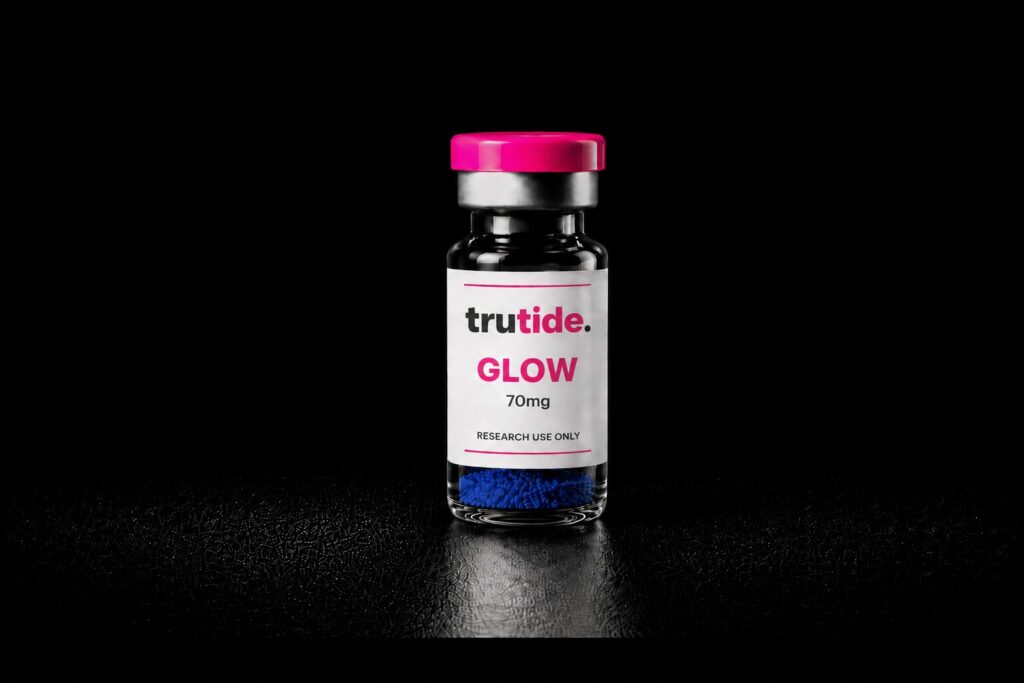
GLOW Blend is a three-component research formulation containing GHK-Cu, BPC-157 and TB-500. The component peptides appear in experimental literature examining copper-peptide chemistry, extracellular-matrix signalling, endothelial pathways, cellular migration and cellular stress responses. This article reviews those mechanisms and the available published evidence for scientific reference.
GLOW is a three-component research formulation containing GHK-Cu, BPC-157 and TB-500. For component-level context, see copper peptides.
Quick reference
| Property | Value |
|---|---|
| Compound class | Three-peptide research blend |
| Components | GHK-Cu + BPC-157 + TB-500 |
| Blend ratio | 50 mg GHK-Cu + 10 mg BPC-157 + 10 mg TB-500 per vial (70 mg total) |
| GHK-Cu sequence | Gly-L-His-L-Lys complexed with Cu(II) |
| BPC-157 sequence | Gly-Glu-Pro-Pro-Pro-Gly-Lys-Pro-Ala-Asp-Asp-Ala-Gly-Leu-Val (15 amino acids) |
| TB-500 sequence | Ac-Lys-Leu-Lys-Lys-Thr-Glu-Thr-Gln (8 amino acids, acetylated) |
| GHK-Cu MW | 402.9 g/mol (copper complex) |
| BPC-157 MW | 1419.53 g/mol |
| TB-500 MW | 889.04 g/mol |
| Form | Lyophilised powder with characteristic blue tint from copper complex |
| Storage | 2–8°C refrigerated; −20°C for long-term lyophilised storage; protect from light and moisture |
Introduction
GLOW Blend is a three-component research formulation containing GHK-Cu, BPC-157 and TB-500. The components have distinct published research profiles involving copper-peptide chemistry, extracellular-matrix signalling, endothelial pathways, nitric-oxide-associated mechanisms and actin-associated cellular migration.
The formulation allows those pathways to be examined within one experimental system. Evidence for the complete blend is more limited than evidence for the individual components, so combination effects should be measured rather than assumed.
Mechanism of action
GHK-Cu — copper-peptide and matrix-associated signalling
GHK-Cu literature includes copper coordination, extracellular-matrix gene expression, fibroblast biology, oxidative-response pathways and endothelial signalling.
BPC-157 — endothelial and nitric-oxide-associated signalling
BPC-157 literature includes VEGF/VEGFR2-associated signalling, nitric-oxide pathways, FAK-paxillin signalling and gastrointestinal or cellular-stress experimental models.
TB-500 — actin-associated cytoskeletal dynamics
TB-500 and thymosin beta-4 literature includes G-actin binding, cytoskeletal organisation, cellular migration and endothelial-response endpoints.
Studying the three pathways together
A multi-component system can be used to examine interactions among these pathways. Results for the blend should be established experimentally and not inferred from single-component studies.
Published research
The published evidence base is strongest for the individual components rather than the commercial three-component formulation.
GHK-Cu research
Studies include dermal fibroblast, extracellular-matrix, oxidative-response, endothelial and other preclinical experimental systems.
BPC-157 research
Studies include gastrointestinal, endothelial, musculoskeletal and neurological experimental models, with the majority of evidence remaining preclinical.
TB-500 research
Research includes actin dynamics, cellular migration, endothelial, epithelial and cardiovascular experimental systems, often using full-length thymosin beta-4 as well as peptide fragments.
Combination research
Direct evidence for the three-component formulation is comparatively limited. Appropriate controls are required to distinguish component-specific, additive and interaction effects.
Limitations of current evidence
Findings from individual peptides cannot automatically be attributed to the combined formulation. Study design, model system and analytical endpoints determine what conclusions are supported.
References
- Pickart L, Margolina A. Regenerative and protective actions of the GHK-Cu peptide in the light of the new gene data. International Journal of Molecular Sciences. 2018;19(7):1987. doi:10.3390/ijms19071987
- Sikiric P, Seiwerth S, Rucman R, et al. Stable gastric pentadecapeptide BPC 157: novel therapy in gastrointestinal tract. Current Pharmaceutical Design. 2011;17(16):1612-1632. doi:10.2174/138161211796196954
- Goldstein AL, Hannappel E, Sosne G, Kleinman HK. Thymosin β4: a multi-functional regenerative peptide. Basic properties and clinical applications. Expert Opinion on Biological Therapy. 2012;12(1):37-51. doi:10.1517/14712598.2012.634793
- McCormack MC, Nowak KC, Koch RJ. Copper peptide GHK-Cu stimulates wound healing, angiogenesis, and hair follicle enlargement in animal models. Wound Repair and Regeneration. 2014;22(2):163-172. doi:10.1111/wrr.12137
- Chang CH, Tsai WC, Lin MS, Hsu YH, Pang JH. The promoting effect of pentadecapeptide BPC 157 on tendon healing involves tendon outgrowth, cell survival, and cell migration. Journal of Applied Physiology. 2011;110(3):774-780. doi:10.1152/japplphysiol.00945.2010
- Sosne G, Qiu P, Goldstein AL, Wheater M. Biological activities of thymosin β4 defined by active sites in short peptide sequences. The FASEB Journal. 2010;24(7):2144-2151. doi:10.1096/fj.09-142307
Last updated: 4 June 2026