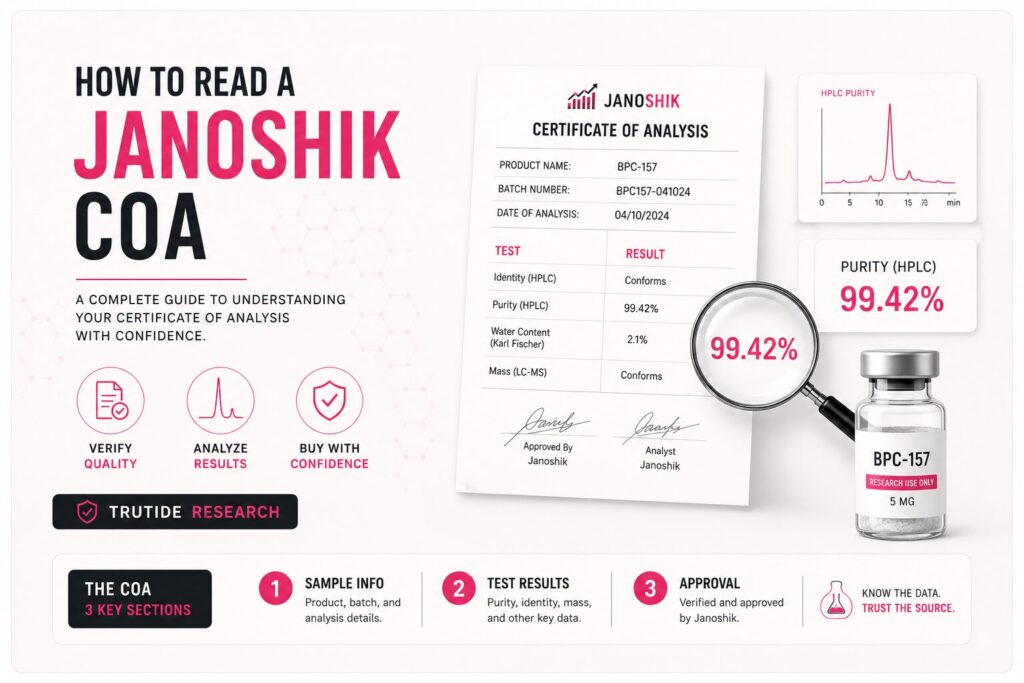
A Certificate of Analysis (COA) can help researchers review analytical data associated with a specified sample or batch. Janoshik Analytical is an independent laboratory used by a number of research-material suppliers. This guide explains how to read common fields on a Janoshik report, including sample identification, chromatographic purity, mass-spectrometry data and net-content results.
What a Janoshik COA contains
| Section | What it tells you |
|---|---|
| Product / peptide identity | Which peptide was tested |
| Batch / lot number | Links the certificate to a specific production batch |
| Test date | When the analysis was performed |
| HPLC purity | The percentage purity of the peptide |
| HPLC chromatogram | The visual trace behind the purity figure |
| Mass spectrometry | Measured molecular mass compared with the expected value |
| Net peptide content | How much actual peptide is in the vial |
| Physical description | Appearance of the material |
Where Trutide provides a Janoshik report, researchers should review the sample or batch reference shown on the report together with the associated product documentation and the scope of the analytical methods reported.
Who is Janoshik Analytical?
As an external analytical laboratory, Janoshik reports results for submitted samples rather than manufacturing the material being tested. The scope of any conclusion should therefore be limited to the sample identified on the report and the analytical methods performed.
This independence is the foundation of the COA’s value as a trust document. When you read a Janoshik COA, you are reading the findings of a third party whose only function is to measure and report.
Reading the identity and batch fields
The top section of the COA establishes what was tested and ties the certificate to a specific batch.
Product / peptide name
This should match the peptide you purchased. Check that the name and any stated quantity correspond to the product — for a blend, the certificate should reflect the blend or its components.
Batch / lot number
This is one of the most important fields for traceability. The batch number links the certificate to a specific production run. A meaningful COA is batch-specific — it documents the testing of the actual batch your vial came from, not a generic certificate reused across all stock. When verifying a COA, the batch number on the certificate should correspond to the batch of the material you received.
Test date
The date the analysis was performed. This confirms the testing is recent enough to be relevant to the current batch and provides a reference point for the material’s age.
Reading the HPLC purity result
The HPLC purity figure is usually the headline number on a COA, and the one most researchers look for first.
What the purity percentage means
High-performance liquid chromatography (HPLC) separates the components of a sample as they pass through a column at different rates. The purity percentage represents the proportion of the sample that is the target peptide, as distinct from synthesis-related impurities, truncated sequences, and degradation products. A figure of ≥98% means at least 98% of the material is the intended peptide. For research applications, ≥98% is the standard benchmark, because impurities present at the concentrations used in research can produce confounding effects. For a fuller explanation of the methodology, see our guide on understanding peptide purity.
Reading the chromatogram
Below or alongside the purity figure, a Janoshik COA includes the HPLC chromatogram — the visual trace the percentage is derived from. The chromatogram plots detector signal against time, and each compound in the sample appears as a peak. The target peptide should appear as a single dominant peak, with the purity percentage corresponding to that peak’s area as a proportion of the total peak area.
What to look for: one large, well-defined main peak, with any additional peaks small and few. A clean chromatogram with a single dominant peak supports the stated purity. A trace with several substantial secondary peaks would indicate a less pure sample, regardless of the headline figure. The chromatogram is the evidence behind the number, which is why a COA that includes it is more transparent than one that states a percentage alone.
Reading the mass spectrometry result
Where HPLC tells you how pure the sample is, mass spectrometry tells you whether it is the right molecule. The two tests answer different questions and are both necessary.
Mass spectrometry measures the molecular weight of the peptide by ionising it and measuring the mass-to-charge ratio. The COA reports the measured molecular weight, which should match the theoretical molecular weight of the target peptide. For example, a BPC-157 COA should show a measured mass corresponding to its theoretical 1419.53 g/mol. A match confirms the sample is the intended peptide; a mismatch would indicate the wrong molecule, an incorrect sequence, or significant modification. This identity confirmation is why mass spectrometry is an essential companion to the HPLC purity figure — a sample could be 99% pure but pure of the wrong compound, and only mass spec catches that.
Reading net peptide content
Net peptide content (sometimes called peptide content or net content) is a field that is often overlooked but important. It addresses a distinct question from purity: of the total dry mass in the vial, how much is actually peptide?
This matters because lyophilised peptides are not 100% peptide by mass. The dry material also contains residual water, counter-ions (such as acetate or trifluoroacetate from synthesis), and other non-peptide content. Purity (from HPLC) describes the proportion of peptide-related material that is the target peptide; net peptide content describes how much of the total vial mass is peptide at all. Both are needed for an accurate picture. A sample can be ≥98% pure by HPLC while the net peptide content is somewhat lower, because the two measure different things. Not all COAs include net peptide content, so its presence is a marker of a more thorough certificate.
Physical description and other fields
The COA may also include a physical description of the material — typically noting a lyophilised white to off-white powder for most peptides, or a blue-tinted powder for copper-containing preparations like GHK-Cu. This provides a simple visual cross-check: the material you receive should match the description. Some certificates include additional tests depending on the peptide and the testing scope requested.
A practical checklist
When reading a Janoshik COA to verify a research peptide, work through these points:
- Does the reported compound name match the material being assessed?
- Is there a batch, lot or sample reference, and is its relationship to the supplied material documented?
- Is the test date recent and relevant to your batch?
- Is the HPLC purity at or above the ≥98% research benchmark?
- Is the chromatogram shown, with a single dominant peak?
- Does the mass spectrometry result match the peptide’s theoretical molecular weight?
- Is net peptide content reported?
- Does the physical description match what you received?
- Is the certificate from an independent laboratory (Janoshik), not self-reported?
A certificate that satisfies all of these points provides strong verification that the material is what it claims to be.
Frequently asked questions
What is a Janoshik COA?
A Janoshik COA is a Certificate of Analysis issued by Janoshik Analytical, an independent third-party testing laboratory widely used in the research peptide field. It documents the results of testing a specific batch of peptide — typically HPLC purity, mass-spectrometry measurement of molecular mass, and net peptide content.
Why does independent testing matter?
A purity figure reported by the manufacturer carries an inherent conflict of interest. An independent laboratory like Janoshik has no commercial stake in the result, so its certificate is a more credible verification. Independence is what gives a third-party COA its value as a trust document.
What is the difference between HPLC purity and mass spectrometry?
HPLC purity tells you how pure the sample is — what proportion is the target peptide versus impurities. Mass spectrometry tells you whether the sample is the correct molecule by measuring its molecular weight against the theoretical value. Purity answers “how clean,” identity answers “is it the right peptide.” Both are needed.
What does the chromatogram show?
The HPLC chromatogram is the visual trace behind the purity percentage. It plots detector signal against time, with each compound appearing as a peak. The target peptide should be a single dominant peak; the purity figure is that peak’s proportion of the total. A clean trace with one main peak supports the stated purity.
What is net peptide content?
Net peptide content is how much of the total dry mass in the vial is actually peptide, as opposed to residual water, counter-ions, and other non-peptide material. It is distinct from HPLC purity, which measures the proportion of peptide-related material that is the target peptide. Both give a complete picture.
How should I assess whether a COA relates to supplied material?
Review the sample, batch or lot reference shown on the certificate together with the supplier’s traceability information. The report demonstrates the results obtained for the sample submitted to the laboratory; whether that sample represents the material supplied depends on documented sampling and chain of custody.
Further reading
For a general explanation of what a Certificate of Analysis is and why it matters, see our guide on what is a Certificate of Analysis. For detail on the purity testing methodology, see understanding peptide purity: what does HPLC mean.
Where Trutide provides a Janoshik report, researchers should review the sample or batch reference shown on the report together with the associated product documentation and the scope of the analytical methods reported.
Last updated: 7 June 2026
Research use only. This article is provided for laboratory and scientific reference purposes. Trutide research products are supplied strictly for in vitro laboratory research and are not for human or veterinary use, clinical use, self-administration, diagnosis, treatment or prevention of disease.