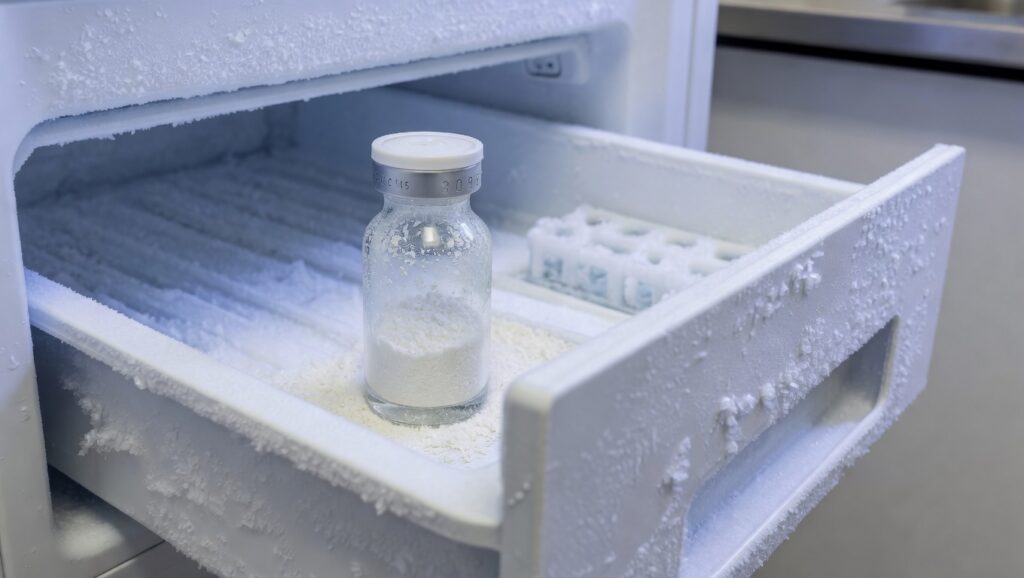
Why storage conditions matter
Research peptides are sensitive biological compounds whose structural integrity and activity can be compromised by improper storage. Exposure to heat, light, moisture, and oxygen can cause peptide bonds to break, amino acid residues to oxidise, or the compound to aggregate. Maintaining appropriate storage conditions from the moment of receipt is essential to ensure experimental reproducibility and to get the maximum value from your research materials.
Storage of lyophilised peptides
Lyophilised (freeze-dried) peptides are significantly more stable than peptides in solution. For most lyophilised research peptides, the recommended storage conditions are:
- Temperature: −20°C (standard laboratory freezer)
- Light: away from direct light — store in the original vial
- Moisture: keep sealed — do not open the vial until ready to use
- Duration: typically stable for 12–24 months under these conditions
For long-term archiving of reference samples, storage at −80°C provides additional stability, particularly for larger or more complex peptides.
Handling on receipt
When a peptide vial arrives, allow it to reach room temperature before opening to prevent condensation forming inside the vial. Condensation introduces moisture which can initiate degradation even before the vial is opened. Once at room temperature, transfer the vial directly to the freezer if it is not to be used immediately.
Storage after reconstitution
Once a lyophilised peptide has been reconstituted in bacteriostatic water or another suitable solvent, the storage requirements change significantly:
- Temperature: 4°C (standard laboratory refrigerator)
- Duration: use within 28 days
- Freeze-thaw cycles: avoid repeated freezing and thawing — each cycle degrades peptide integrity
If a reconstituted peptide solution will not be used within 28 days, it should be aliquoted into single-use volumes before freezing. This allows individual aliquots to be thawed as needed without subjecting the entire stock to repeated freeze-thaw cycles.
Aliquoting for long-term storage
To minimise degradation from freeze-thaw cycles, reconstituted peptide solutions can be aliquoted into smaller volumes using sterile low-binding microcentrifuge tubes. Label each aliquot clearly with the compound name, concentration, date of reconstitution, and aliquot number. Store at −20°C and thaw only the volume needed for each experiment.
Signs of peptide degradation
Researchers should be alert to the following signs that a peptide may have degraded:
- Cloudiness or particulates in a reconstituted solution that was previously clear
- Discolouration of the powder or solution
- Unusual odour
- Unexpected experimental results inconsistent with previous data
If degradation is suspected, the material should be set aside and a fresh vial used. Do not use degraded material in research experiments as results will be unreliable.
Peptide-specific considerations
Some peptides have specific storage requirements due to their chemical properties. Peptides containing cysteine residues are particularly susceptible to oxidation and may require storage under inert gas (nitrogen or argon) or with the addition of a reducing agent such as DTT. Always consult the relevant literature and the Certificate of Analysis for your specific compound before establishing a storage protocol.
All Trutide research peptides are supplied as lyophilised powder with storage instructions on the label. For any storage-related queries, contact us at support@trutide.co.uk.