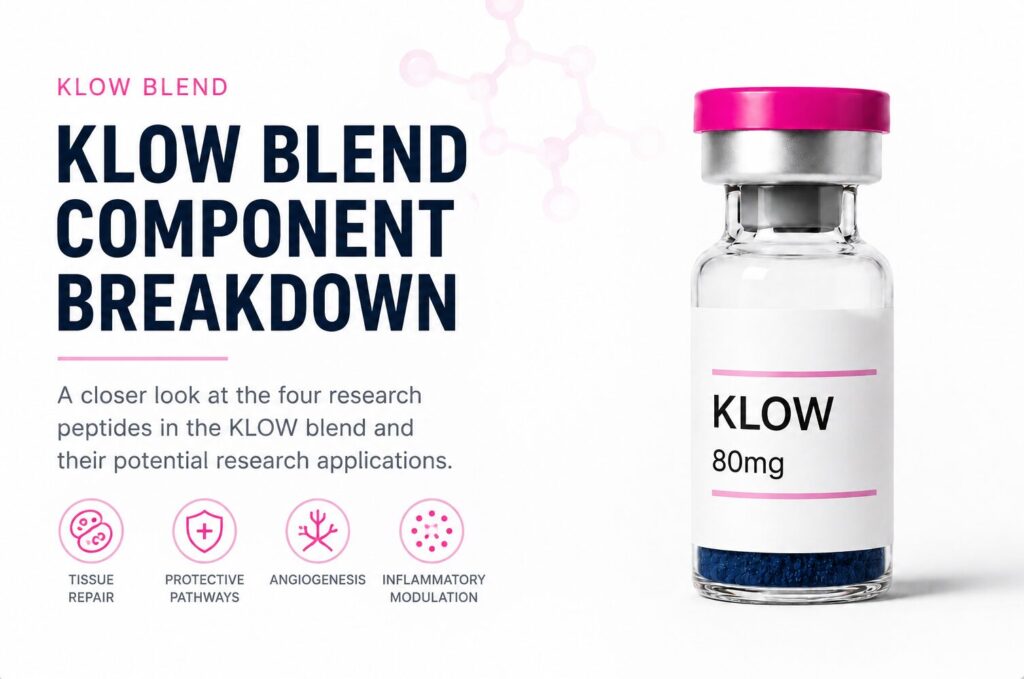
KLOW Blend contains four research peptides in a fixed formulation: GHK-Cu, BPC-157, TB-500 and KPV. This component breakdown focuses on the molecular identity and published mechanistic literature associated with each peptide, and on how their signalling pathways may be examined within a multi-component experimental system.
The four components at a glance
| Component | Amount | Primary pathway |
|---|---|---|
| GHK-Cu | 50 mg | Matrix remodelling + antioxidant (copper-dependent) |
| BPC-157 | 10 mg | Angiogenesis + cytoprotection |
| TB-500 | 10 mg | Actin sequestration + cellular migration |
| KPV | 10 mg | Receptor-independent inflammatory-signalling |
| Total | 80 mg per vial, four pathways | |
Why four distinct components?
The four peptides are structurally different and appear in separate areas of experimental literature. Studying them together can support questions about interactions among copper-peptide chemistry, extracellular-matrix signalling, endothelial pathways, actin-associated migration and inflammatory mediators.
Combination-specific evidence is limited, so effects reported for individual components should not be assumed to occur in the four-component formulation.
Component 1: GHK-Cu (50 mg)
GHK-Cu is a copper-binding tripeptide studied in systems involving copper coordination, extracellular-matrix gene expression, fibroblast biology, oxidative-response mechanisms and endothelial signalling. The 50 mg quantity describes the formulation composition; it does not imply that GHK-Cu determines a particular outcome of the blend.
Component 2: BPC-157 (10 mg)
BPC-157 is a synthetic 15-amino-acid peptide studied in preclinical models involving nitric-oxide-associated signalling, VEGF/VEGFR2 pathways, FAK-paxillin signalling, endothelial responses and gastrointestinal cell or tissue systems.
Component 3: TB-500 (10 mg)
TB-500 is a thymosin beta-4-derived peptide used in research on G-actin binding, cytoskeletal organisation, cellular migration and endothelial-response endpoints.
Component 4: KPV (10 mg)
KPV is an α-MSH-derived tripeptide studied in systems involving PepT1-mediated uptake, NF-κB and MAPK signalling and inflammatory mediators. It is mechanistically distinct from melanocortin-receptor agonists.
How the mechanisms differ
- GHK-Cu: copper coordination, extracellular-matrix signalling and copper-dependent biochemical processes.
- BPC-157: endothelial, nitric-oxide-associated and cellular stress-response pathways.
- TB-500: actin-associated cytoskeletal organisation and cellular migration.
- KPV: intracellular inflammatory-signalling pathways including NF-κB- and MAPK-associated mechanisms.
Research on the four-component combination is more limited than research on the individual peptides. Experimental work with the blend should therefore use controls capable of distinguishing component-specific and combination-specific effects.
KLOW vs GLOW vs Wolverine
KLOW, GLOW and Wolverine differ by composition. Wolverine contains BPC-157 and TB-500; GLOW adds GHK-Cu; KLOW additionally contains KPV. These differences provide different combinations of experimental pathways, but no hierarchy of expected biological outcome should be inferred from the number of components.
References
- Pickart L, Margolina A. Regenerative and protective actions of the GHK-Cu peptide in the light of the new gene data. International Journal of Molecular Sciences. 2018;19(7):1987. doi:10.3390/ijms19071987
- Sikiric P, Seiwerth S, Rucman R, et al. Stable gastric pentadecapeptide BPC 157: novel therapy in gastrointestinal tract. Current Pharmaceutical Design. 2011;17(16):1612-1632. doi:10.2174/138161211796196954
- Goldstein AL, Hannappel E, Sosne G, Kleinman HK. Thymosin β4: a multi-functional regenerative peptide. Basic properties and clinical applications. Expert Opinion on Biological Therapy. 2012;12(1):37-51. doi:10.1517/14712598.2012.634793
- Dalmasso G, Charrier-Hisamuddin L, Nguyen HT, et al. PepT1-mediated tripeptide KPV uptake reduces intestinal inflammation. Gastroenterology. 2008;134(1):166-178. doi:10.1053/j.gastro.2007.10.026
- Kannengiesser K, Maaser C, Heidemann J, et al. Melanocortin-derived tripeptide KPV has anti-inflammatory potential in murine models of inflammatory bowel disease. Inflammatory Bowel Diseases. 2008;14(3):324-331. doi:10.1002/ibd.20334
Last updated: 6 June 2026