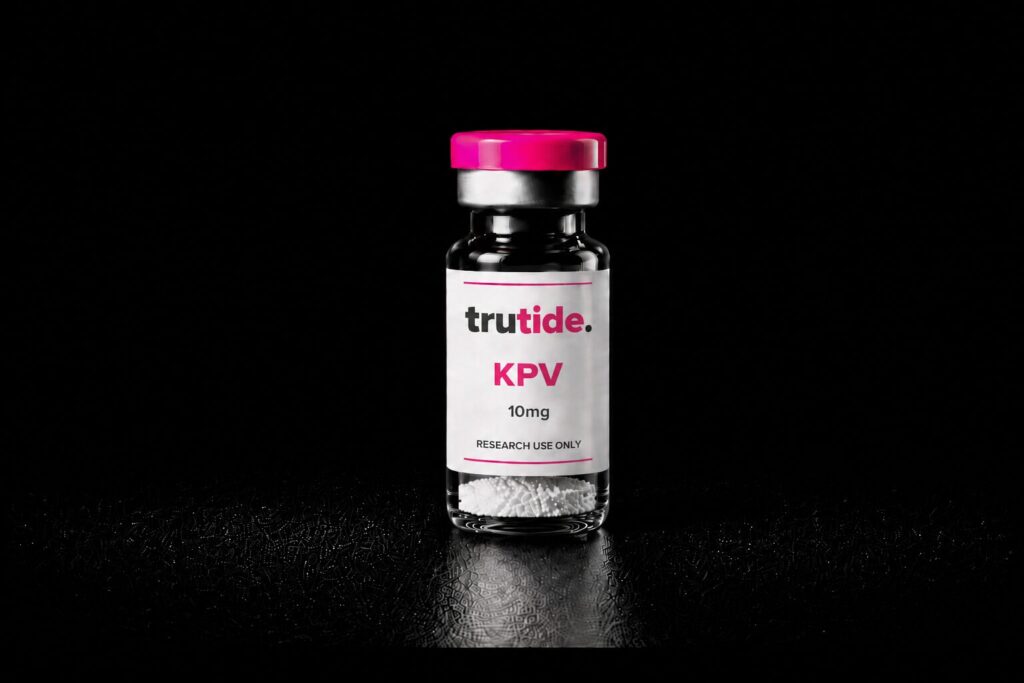
KPV (Lys-Pro-Val) is a tripeptide derived from the C-terminal region of α-melanocyte-stimulating hormone (α-MSH). It is used in experimental research examining intracellular inflammatory signalling, peptide transport and related cellular regulatory mechanisms. This article summarises the published laboratory and preclinical literature for scientific reference.
Quick reference
| Property | Value |
|---|---|
| Compound class | Synthetic tripeptide; α-MSH-derived research fragment |
| Sequence | Lys-Pro-Val (KPV) |
| Source sequence | C-terminal tripeptide of α-MSH (residues 11–13) |
| Molecular formula | C₁₆H₃₀N₄O₄ |
| Molecular weight | 342.44 g/mol |
| CAS number | 67727-97-3 |
| Mechanism | Receptor-independent intracellular inflammatory-signalling activity |
| Form | Lyophilised white powder |
| Storage | 2–8°C refrigerated; −20°C for long-term lyophilised storage; protect from light and moisture |
Introduction
KPV is a synthetic tripeptide composed of L-lysine, L-proline, and L-valine. The sequence corresponds to the C-terminal three amino acids (residues 11–13) of α-melanocyte-stimulating hormone (α-MSH), a 13-amino-acid peptide hormone involved in melanocortin and immune-signalling pathways. KPV was identified in published research as a short α-MSH-derived fragment retaining measurable activity in inflammatory-signalling models, and has subsequently been studied as a research tool in its own right.
The key feature distinguishing KPV from α-MSH itself, and from other melanocortin-derived peptides such as Melanotan 2 or afamelanotide, is its mechanism of action. KPV exerts its biological activity through a receptor-independent intracellular pathway rather than by binding melanocortin receptors. This makes it mechanistically distinct from melanocortin agonists despite sharing a structural relationship to them, and the distinction is important when interpreting research findings.
Published research on KPV spans more than two decades and includes work on inflammatory bowel disease models, skin inflammation, ocular inflammation, and broader inflammatory-signalling pathway research. Its small size and receptor-independent mechanism make it useful for studying inflammatory-signalling responses separately from classical melanocortin-receptor activation.
Mechanism of action
KPV is studied as a receptor-independent α-MSH-derived tripeptide. Published research investigates intracellular uptake and changes in inflammatory-signalling pathways rather than classical melanocortin-receptor agonism.
Receptor-independent activity
KPV lacks the central α-MSH receptor-binding pharmacophore and shows minimal melanocortin-receptor activation under conditions used in published inflammatory-signalling studies.
Intracellular uptake and NF-κB modulation
Studies have examined PepT1-mediated cellular uptake and reported changes in NF-κB nuclear translocation and downstream inflammatory-mediator expression in defined cellular models.
MAP kinase pathway modulation
Published work also reports changes in p38 MAPK, JNK and related signalling measurements in experimentally stimulated cellular systems.
Experimental context
The magnitude and direction of reported effects depend on the model, stimulus, cell type and assay. These observations should not be generalised into a therapeutic claim.
Published research
KPV research is dominated by preclinical inflammatory-signalling models. The sections below describe experimental systems and endpoints reported in the literature.
Gastrointestinal experimental models
Animal and cellular studies have examined KPV in induced-colitis and intestinal-epithelial systems, measuring cytokine expression, barrier-associated markers, histological endpoints and PepT1-associated uptake.
Skin experimental models
Published work includes skin-cell and animal models in which inflammatory mediators, cellular infiltration and related signalling endpoints were measured.
Ocular experimental models
KPV has been examined in ocular inflammatory model systems, with studies reporting model-specific molecular, cellular and histological endpoints.
General inflammatory-signalling research
KPV is also used as a tool for studying NF-κB, MAPK, PepT1 and receptor-independent peptide signalling in cellular systems.
Limitations of current evidence
The evidence base is predominantly preclinical. Findings vary by model and should not be extrapolated to human or veterinary outcomes.
References
- Dalmasso G, Charrier-Hisamuddin L, Nguyen HT, et al. PepT1-mediated tripeptide KPV uptake reduces intestinal inflammation. Gastroenterology. 2008;134(1):166-178. doi:10.1053/j.gastro.2007.10.026
- Catania A, Lonati C, Sordi A, Carlin A, Leonardi P, Gatti S. The melanocortin system in control of inflammation. The Scientific World Journal. 2010;10:1840-1853. doi:10.1100/tsw.2010.173
- Brzoska T, Luger TA, Maaser C, Abels C, Böhm M. α-Melanocyte-stimulating hormone and related tripeptides: biochemistry, antiinflammatory and protective effects in vitro and in vivo, and future perspectives for the treatment of immune-mediated inflammatory diseases. Endocrine Reviews. 2008;29(5):581-602. doi:10.1210/er.2007-0027
- Kannengiesser K, Maaser C, Heidemann J, et al. Melanocortin-derived tripeptide KPV has anti-inflammatory potential in murine models of inflammatory bowel disease. Inflammatory Bowel Diseases. 2008;14(3):324-331. doi:10.1002/ibd.20334
- Cutuli M, Cristiani S, Lipton JM, Catania A. Antimicrobial effects of alpha-MSH peptides. Journal of Leukocyte Biology. 2000;67(2):233-239. doi:10.1002/jlb.67.2.233
- Hiltz ME, Lipton JM. Antiinflammatory activity of a COOH-terminal fragment of the neuropeptide α-MSH. The FASEB Journal. 1989;3(11):2282-2284. doi:10.1096/fasebj.3.11.2550304
Last updated: 4 June 2026