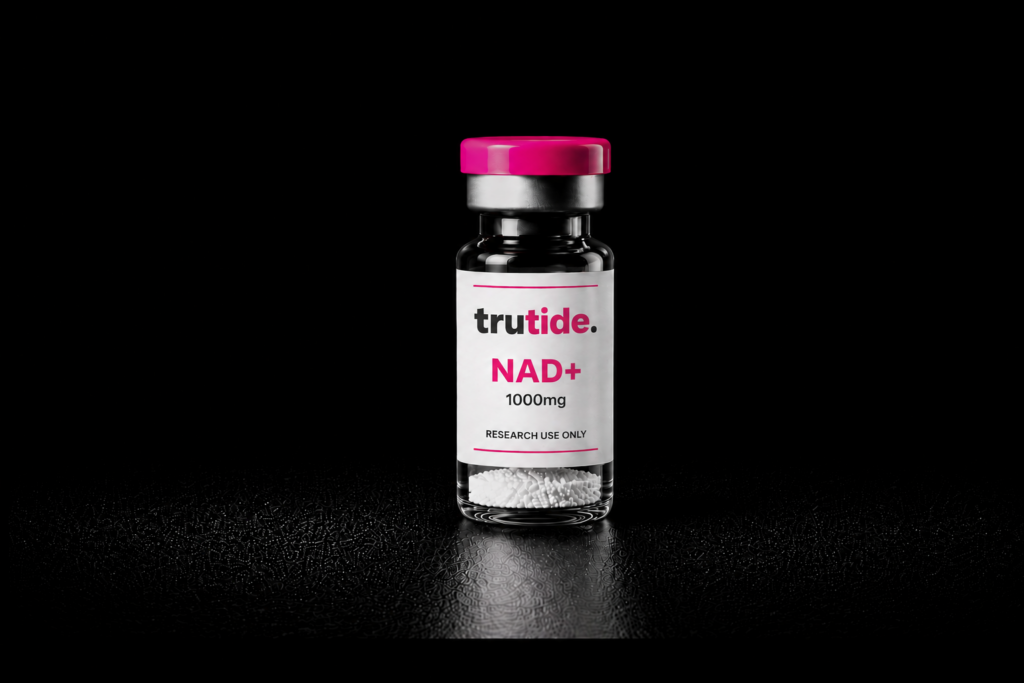
Nicotinamide adenine dinucleotide (NAD+) is a naturally occurring dinucleotide coenzyme central to redox chemistry, cellular metabolism and NAD-dependent enzyme systems. This article reviews its biochemical roles, metabolism and published research involving mitochondrial processes, PARP-associated signalling, sirtuin activity and cellular energy regulation.
Quick reference
| Property | Value |
|---|---|
| Compound class | Dinucleotide coenzyme (oxidised form) |
| Full name | Nicotinamide adenine dinucleotide |
| Molecular formula | C₂₁H₂₇N₇O₁₄P₂ |
| Molecular weight | 663.43 g/mol |
| CAS number | 53-84-9 |
| Vial content | 1000 mg (1g) per vial |
| Form | Lyophilised white to off-white powder |
| Storage | 2–8°C refrigerated; −20°C for long-term lyophilised storage; protect from light and moisture |
Introduction
Nicotinamide adenine dinucleotide (NAD+) is a dinucleotide composed of two nucleotides — nicotinamide and adenine — joined through their phosphate groups. It exists in two interconvertible forms: the oxidised form (NAD+) and the reduced form (NADH), which together function as a redox pair central to electron transfer reactions in cellular metabolism.
Unlike most compounds in the research peptide space, NAD+ is a naturally occurring coenzyme found throughout cellular biology. Its role has been studied for more than a century, from early work on redox chemistry to modern research examining NAD-dependent enzymes, mitochondrial processes and age-associated changes in cellular NAD+ pools.
Published studies have reported age-associated differences in NAD+ levels across multiple mammalian tissues. This observation has prompted research into NAD+ metabolism, precursor pathways and cellular models of age-associated biochemical change.
Biological roles
NAD+ participates in three broad categories of cellular function, each of which has driven a distinct branch of published research.
Redox reactions and energy metabolism
The most extensively characterised role of NAD+ is as an electron acceptor in catabolic pathways. In glycolysis, the citric acid cycle, and fatty acid oxidation, NAD+ accepts electrons from substrates and becomes NADH. The NADH then donates these electrons to the mitochondrial electron transport chain, ultimately driving ATP synthesis through oxidative phosphorylation.
The NAD+/NADH ratio in cells is a fundamental indicator of metabolic state — a high ratio reflects an oxidised, energy-deficient environment, while a low ratio reflects a reduced, energy-replete state. Published research has demonstrated that this ratio influences hundreds of downstream cellular processes, making NAD+ a master regulator of cellular metabolism.
Sirtuin activation
The sirtuins (SIRT1 through SIRT7) are a family of NAD+-dependent enzymes that act as cellular sensors of metabolic state. They use NAD+ as a substrate to remove acetyl and other acyl groups from histones and other proteins, regulating gene expression, DNA repair, and stress responses.
Published research has identified sirtuins as key mediators of cellular responses to caloric restriction, oxidative stress, and ageing. Because sirtuins consume NAD+ in their catalytic cycle, NAD+ availability is rate-limiting for sirtuin activity — making cellular NAD+ levels a direct determinant of how strongly these regulatory enzymes can function. This is one of the central mechanisms through which declining NAD+ levels with age have been linked to age-related cellular dysfunction (Imai & Guarente, 2014).
PARP-mediated DNA repair
Poly(ADP-ribose) polymerases (PARPs), particularly PARP1, consume NAD+ as a substrate to attach ADP-ribose chains onto proteins involved in DNA damage response. Following DNA damage, PARP1 activity can increase 500-fold, dramatically depleting cellular NAD+ pools.
Published research has shown that this PARP-mediated NAD+ consumption creates competition with sirtuins for the available NAD+ pool. Chronic DNA damage in aged tissues may therefore deplete NAD+ to the point where sirtuin function becomes impaired — a mechanism with implications for research into ageing, cancer, and neurodegeneration.
CD38 and cellular signalling
CD38 is an NAD+-consuming enzyme expressed on immune cells and increasingly recognised as a major regulator of NAD+ levels in ageing tissues. Published research has reported that CD38 expression increases with age, contributing to the decline in tissue NAD+ levels (Camacho-Pereira et al., 2016).
CD38 also generates cyclic ADP-ribose, a calcium-mobilising second messenger involved in cellular signalling. The dual role of CD38 in NAD+ consumption and calcium signalling makes it a target of significant research interest.
NAD+ metabolism and precursors
Understanding NAD+ research requires understanding how cells synthesise NAD+. There are three primary biosynthesis pathways, each starting from a different precursor.
De novo synthesis from tryptophan
The amino acid tryptophan can be converted to NAD+ through an eight-step pathway involving kynurenine intermediates. This is the only pathway that creates NAD+ from amino acid building blocks rather than recycling existing nicotinamide moieties. It is a minor contributor to cellular NAD+ pools in most tissues.
Salvage pathway from nicotinamide
The dominant route of NAD+ regeneration in mammalian cells. Nicotinamide (released by sirtuins, PARPs, and CD38 during their catalytic cycles) is converted by the enzyme NAMPT (nicotinamide phosphoribosyltransferase) into nicotinamide mononucleotide (NMN), which is then converted to NAD+ by NMNAT enzymes.
NAMPT is rate-limiting in this pathway and is one of the most-studied targets in NAD+ research. Published research has shown NAMPT activity declines with age in multiple tissues, contributing to falling NAD+ levels.
Preiss-Handler pathway from nicotinic acid
Nicotinic acid (niacin) is converted to NAD+ through a three-step pathway involving nicotinic acid mononucleotide (NaMN) and nicotinic acid adenine dinucleotide (NaAD).
Research on NAD+ precursors
Much published NAD+ research uses the precursors NMN (nicotinamide mononucleotide) and NR (nicotinamide riboside) rather than NAD+ directly. This is because intact NAD+ is a large, charged molecule that does not readily cross cell membranes — whereas NMN and NR are taken up more efficiently and converted intracellularly to NAD+.
Direct NAD+ administration is used in research contexts where:
- Specific tissue distribution patterns are being studied
- Comparative studies against precursors are required
- Cellular extract preparations require pre-formed NAD+
- In vitro enzymatic studies need the active coenzyme directly
Published research
The literature on NAD+ and its precursors spans many experimental disciplines. The examples below summarise major research areas without implying that findings from precursor studies apply directly to Trutide NAD+ material.
Age-associated cellular research
Studies have characterised changes in NAD+ pools, NAMPT activity, CD38 expression and PARP-associated consumption across age-related experimental models. Much intervention research in this field uses precursors such as NMN or NR rather than direct NAD+.
Metabolic research
Published work has examined NAD-dependent redox chemistry, mitochondrial function and precursor metabolism in cellular and animal metabolic models. Results depend on the specific compound, route and experimental system used.
Neurological research
NAD+ metabolism is studied in neuronal systems including SARM1-associated axonal degeneration and other models of neuronal stress. These studies investigate biochemical pathways rather than establishing a therapeutic use for supplied research material.
Cardiovascular research
Experimental literature includes work on NAD metabolism, mitochondrial bioenergetics and precursor pathways in cardiac models. Many cited studies use NR, NMN or other interventions rather than direct NAD+.
Human research context
Human studies have examined several NAD-related compounds and precursors, commonly focusing on pharmacokinetics, tolerability and biochemical biomarkers. Results from those studies should not be extrapolated to unlicensed research material or treated as instructions for use.
NAD+ versus NMN and NR
NAD+, NMN and NR are chemically distinct research materials. NAD+ is the dinucleotide coenzyme itself, while NMN and NR are precursors that enter NAD biosynthetic pathways.
NAD+: commonly used directly in biochemical or enzymatic systems where the coenzyme itself is required.
NMN: an intermediate in NAD biosynthesis and a frequent subject of cellular and in vivo precursor research.
NR: a nicotinamide riboside precursor used in experimental and human research on NAD metabolism.
Choice of material depends on the experimental question, assay system and validated protocol. Findings from one material should not be assumed to apply to another.
References
- Imai S, Guarente L. NAD+ and sirtuins in aging and disease. Trends in Cell Biology. 2014;24(8):464-471. doi:10.1016/j.tcb.2014.04.002
- Yoshino J, Mills KF, Yoon MJ, Imai S. Nicotinamide mononucleotide, a key NAD(+) intermediate, treats the pathophysiology of diet- and age-induced diabetes in mice. Cell Metabolism. 2011;14(4):528-536.
- Gomes AP, Price NL, Ling AJ, et al. Declining NAD(+) induces a pseudohypoxic state disrupting nuclear-mitochondrial communication during aging. Cell. 2013;155(7):1624-1638.
- Camacho-Pereira J, Tarragó MG, Chini CCS, et al. CD38 Dictates Age-Related NAD Decline and Mitochondrial Dysfunction through an SIRT3-Dependent Mechanism. Cell Metabolism. 2016;23(6):1127-1139. doi:10.1016/j.cmet.2016.05.006
- Cantó C, Houtkooper RH, Pirinen E, et al. The NAD(+) precursor nicotinamide riboside enhances oxidative metabolism and protects against high-fat diet-induced obesity. Cell Metabolism. 2012;15(6):838-847.
- Gerdts J, Brace EJ, Sasaki Y, DiAntonio A, Milbrandt J. SARM1 activation triggers axon degeneration locally via NAD+ destruction. Science. 2015;348(6233):453-457.
- Diguet N, Trammell SAJ, Tannous C, et al. Nicotinamide Riboside Preserves Cardiac Function in a Mouse Model of Dilated Cardiomyopathy. Circulation. 2018;137(21):2256-2273.
- Martens CR, Denman BA, Mazzo MR, et al. Chronic nicotinamide riboside supplementation is well-tolerated and elevates NAD+ in healthy middle-aged and older adults. Nature Communications. 2018;9(1):1286.
Last updated: 19 May 2026