What is peptide purity?
Peptide purity refers to the proportion of the desired peptide compound relative to all other substances present in a sample. These other substances — collectively known as impurities — may include truncated sequences, deletion peptides, oxidised variants, aggregates, residual reagents from the synthesis process, or other related compounds. Purity is expressed as a percentage, where a purity of 98% means that 98% of the measurable content of the sample is the target peptide, with the remaining 2% comprising impurities.
What is HPLC?
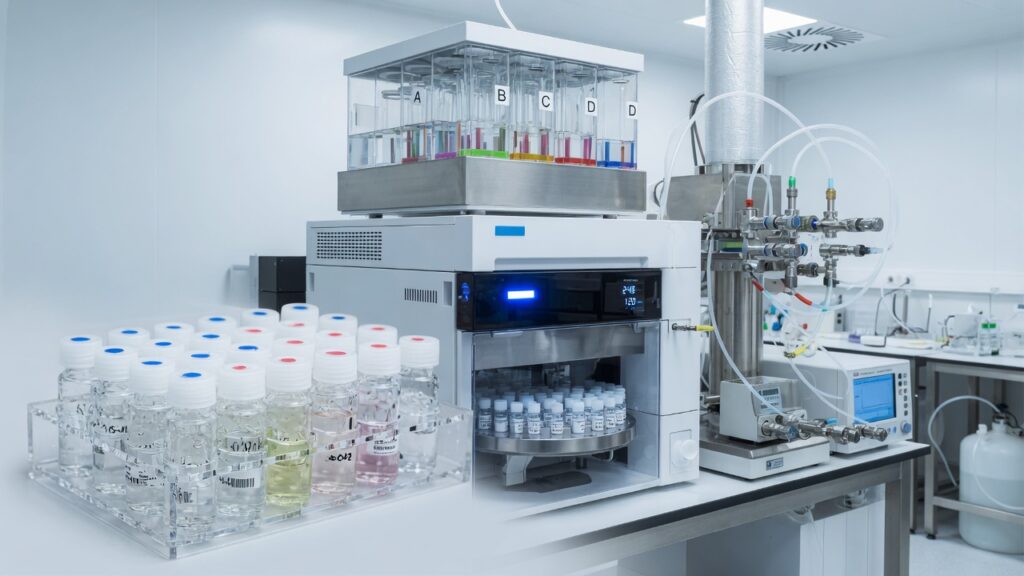
High-Performance Liquid Chromatography (HPLC) is a widely used analytical technique for assessing peptide purity. The technique works by dissolving the sample in a solvent and passing it through a column packed with a stationary phase material under high pressure. Different compounds in the sample interact with the stationary phase to different degrees, causing them to travel through the column at different speeds. This separates the components of the mixture, which are then detected as they exit the column — typically using UV absorbance at 214nm or 220nm, wavelengths at which peptide bonds absorb strongly.
How is purity calculated from HPLC?
The HPLC detector produces a chromatogram — a graph plotting detector signal against time. Each compound in the sample appears as a peak. Purity is calculated by expressing the area of the target peptide peak as a percentage of the total area of all peaks in the chromatogram:
Purity (%) = (Target peak area ÷ Total peak area) × 100
A well-synthesised research peptide will show a dominant peak corresponding to the target sequence, with minor peaks representing any impurities present.
Reverse-phase HPLC (RP-HPLC)
The most common form of HPLC used in peptide analysis is reverse-phase HPLC (RP-HPLC), which uses a non-polar stationary phase and a polar mobile phase. Compounds are separated based on their hydrophobicity — more hydrophobic compounds are retained longer on the column and elute later. RP-HPLC is well suited to peptide analysis because peptides of different sequences typically have distinct hydrophobicity profiles, allowing good separation of the target peptide from related impurities.
What purity level is appropriate for research?
Trutide peptide and compound products are independently tested using HPLC against the applicable analytical specification. Batch-specific COA documentation is available on request.
HPLC and mass spectrometry together
HPLC is used to assess chromatographic purity and separation behaviour; it does not by itself establish molecular identity. Mass spectrometry can measure the molecular mass of a peptide and compare that result with the expected theoretical value. A matching measured mass can support identity assessment, but a simple intact-mass measurement does not by itself establish the full amino-acid sequence.
Where sequence-level confirmation is required, laboratories may use additional or orthogonal methods such as tandem mass spectrometry (MS/MS), peptide mapping or other validated characterisation techniques. Analytical conclusions should therefore be read in the context of the specific methods reported on the certificate.