CJC-1295 is available in two distinct forms that are frequently confused: CJC-1295 with DAC (Drug Affinity Complex) and CJC-1295 without DAC (also called Modified GRF 1-29 or CJC-1295 no DAC). Both are synthetic analogues of growth hormone-releasing hormone (GHRH) and both bind the same receptor through the same mechanism. The single difference between them — the presence or absence of the Drug Affinity Complex — produces a dramatic difference in pharmacokinetics that fundamentally changes how each is used in research. This guide explains the chemistry behind the DAC modification, the resulting differences in half-life and growth hormone release dynamics, and what those differences mean for research design.
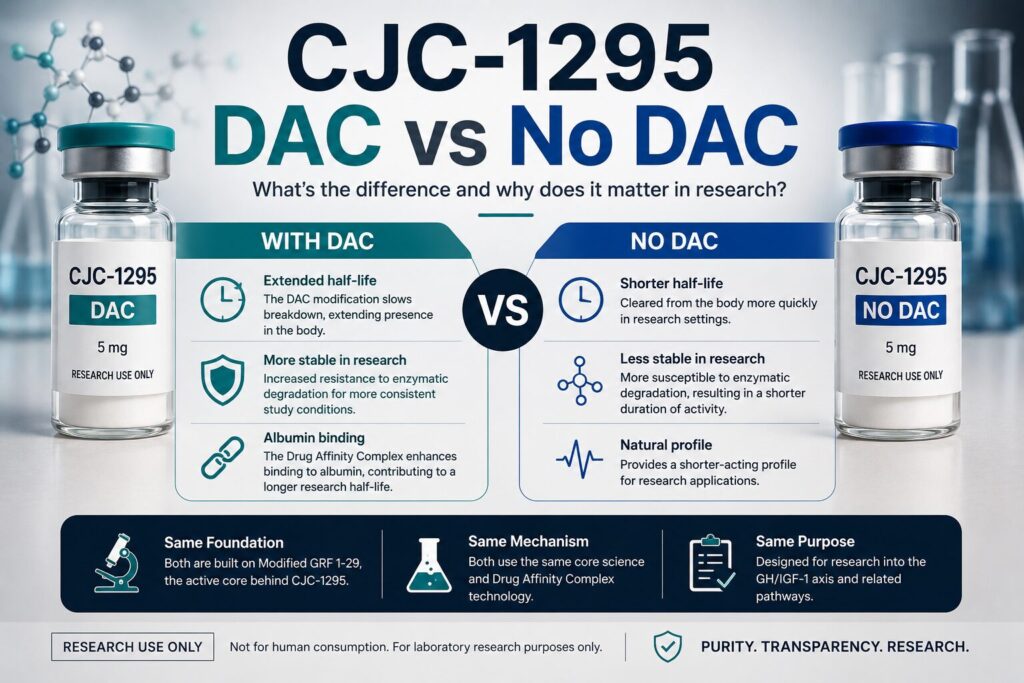
DAC vs no DAC at a glance
| Property | CJC-1295 with DAC | CJC-1295 (no DAC) |
|---|---|---|
| Also known as | CJC-1295 DAC, CJC-1295 | Modified GRF 1-29, CJC-1295 no DAC |
| Drug Affinity Complex | Present | Absent |
| Albumin binding | Yes (covalent) | No |
| Plasma half-life | ~6–8 days | ~30 minutes |
| GH release pattern | Sustained elevation (“bleed”) | Discrete pulses |
| Receptor target | GHRH receptor | GHRH receptor |
| Receptor mechanism | Identical | Identical |
| Typical research pairing | Sustained-pathway studies | Often studied alongside ghrelin-receptor signalling |
| CAS number | 863288-34-0 (base sequence) | 863288-34-0 (base sequence) |
The shared foundation: Modified GRF 1-29
Both forms of CJC-1295 are built on the same peptide backbone: a 29-amino-acid analogue of the first 29 residues of growth hormone-releasing hormone, the segment of native GHRH that contains the receptor-binding domain. This base molecule is itself a modified version of native GRF(1-29), incorporating four amino acid substitutions that confer resistance to enzymatic degradation.
The most important of these substitutions is a D-alanine at position 2, which protects the peptide against dipeptidyl peptidase IV (DPP-IV) — the enzyme primarily responsible for degrading native GHRH within minutes of release. Additional substitutions (at positions 8, 15, and 27) further improve stability and manufacturing consistency. This modified base molecule is what is referred to as “Modified GRF 1-29,” and it is the foundation shared by both CJC-1295 variants.
At this point, the two variants diverge. CJC-1295 no DAC is Modified GRF 1-29 — the base molecule used as-is. CJC-1295 with DAC takes the same base molecule and adds the Drug Affinity Complex.
What the Drug Affinity Complex does
The Drug Affinity Complex is the single feature that separates the two variants, and understanding it is the key to understanding everything else about the comparison.
The conjugation chemistry
The DAC is a maleimido propionic acid (MPA) group attached to the lysine residue at position 30 of the peptide. The maleimide functional group is highly reactive toward thiol (–SH) groups, and specifically toward the free cysteine-34 residue present on circulating serum albumin. When CJC-1295 with DAC enters the bloodstream, the maleimide group forms a covalent bond with albumin’s cysteine-34, effectively tethering the peptide to a large, long-lived plasma protein.
Why albumin binding extends half-life
Serum albumin is the most abundant protein in plasma and has a circulating half-life of approximately 19 days. By covalently binding to albumin, CJC-1295 with DAC effectively “borrows” albumin’s long residence time. The bound peptide is protected from renal filtration (it is now far too large to pass through the glomerulus) and from many proteolytic clearance pathways. The result is a plasma half-life of approximately 6–8 days — a roughly 300-fold increase over the ~30-minute half-life of the no-DAC form.
This albumin-tethering strategy is not unique to CJC-1295. The same principle underlies the extended half-lives of several modern peptide therapeutics, although most use non-covalent fatty acid acylation rather than covalent maleimide conjugation. The covalent approach used by the DAC produces a particularly durable extension.
The consequence: pulses vs saturation
The pharmacokinetic difference is not just a matter of duration — it changes the fundamental pattern of growth hormone release, and this is the distinction that matters most for research design.
No DAC: pulsatile release
Because CJC-1295 no DAC clears within roughly 30 minutes, it produces a discrete, time-limited pulse of GHRH receptor stimulation. This approximates the body’s own physiological pattern, in which GHRH is released in pulses and growth hormone follows in corresponding bursts. Pulsatile signalling is considered physiologically important because continuous receptor stimulation can lead to receptor desensitisation, whereas pulsatile stimulation preserves receptor responsiveness over time. The short half-life is why the no-DAC form is the variant typically chosen for research approximating physiological GHRH dynamics, and why it is usually paired with a short-acting ghrelin receptor agonist such as Ipamorelin to produce a coordinated pulse through two complementary pathways.
With DAC: sustained elevation
Because CJC-1295 with DAC persists in plasma for days, it produces continuous GHRH receptor stimulation rather than discrete pulses. Published research has described this as producing a sustained elevation or “bleed” of growth hormone and IGF-1 across the observation period, rather than the sharp pulses seen with the no-DAC form. Notably, published research has reported that some degree of GH pulsatility is preserved even under continuous DAC stimulation, because pulsatility is partly governed by the hypothalamic-pituitary axis itself rather than solely by the timing of GHRH exposure. Nonetheless, the overall pattern is one of sustained elevation rather than discrete pulses.
The research design implication
This difference determines which variant suits a given research question. Research investigating pulsatile GHRH signalling, physiological release patterns, or the interaction between GHRH and ghrelin pathways calls for the no-DAC form. Research investigating sustained pathway activation may use the DAC form, while research focused on shorter receptor-exposure windows may use the no-DAC form. The two are not interchangeable, and published findings using one cannot be directly extrapolated to the other.
Why no DAC is the common choice for blends
The no-DAC form is the variant almost always used in combination blends with ghrelin receptor agonists like Ipamorelin, and the reasoning follows directly from the kinetics discussed above.
The rationale for combining a GHRH analogue with a ghrelin agonist is to produce a coordinated, synergistic pulse of growth hormone release by simultaneously stimulating two complementary pituitary pathways. This synergy depends on both peptides acting within the same time window. Ipamorelin has a half-life of approximately 2 hours, which is compatible with the ~30-minute pulse produced by no-DAC CJC-1295 — both act within an overlapping window to produce a single coordinated pulse.
Frequently asked questions
What is the difference between CJC-1295 with and without DAC?
Both are the same base peptide (Modified GRF 1-29) and bind the same GHRH receptor through the same mechanism. The difference is the Drug Affinity Complex — a maleimide group that covalently binds the peptide to serum albumin. The DAC form has a half-life of approximately 6–8 days and produces sustained growth hormone elevation; the no-DAC form has a half-life of approximately 30 minutes and produces discrete pulses.
Is CJC-1295 no DAC the same as Modified GRF 1-29?
Yes. CJC-1295 no DAC and Modified GRF 1-29 refer to the same molecule — the 29-amino-acid GHRH analogue base without the Drug Affinity Complex. The terms are used interchangeably in research contexts.
Why does the DAC form last so much longer?
The DAC form covalently binds to serum albumin, the most abundant plasma protein, which has a circulating half-life of around 19 days. By tethering to albumin, the peptide is protected from renal filtration and proteolytic clearance, extending its half-life from approximately 30 minutes (no DAC) to approximately 6–8 days (DAC).
Which form is used in CJC-1295 / Ipamorelin blends?
The no-DAC form. Its short half-life produces a discrete pulse that aligns with the ~2-hour half-life of Ipamorelin, allowing the two peptides to act within the same window and produce a coordinated synergistic effect. The DAC form’s multi-day sustained stimulation would not align with a short-acting ghrelin agonist in the same way.
Do the two forms bind different receptors?
No. Both bind the same GHRH receptor through the same molecular interaction. The DAC modification affects only pharmacokinetics (how long the peptide remains in circulation), not the receptor target or the binding mechanism.
Further reading
Research use only. This article is provided for laboratory and scientific reference purposes. Trutide research products are supplied strictly for in vitro laboratory research and are not for human or veterinary use, clinical use, self-administration, diagnosis, treatment or prevention of disease.
References
- Teichman SL, Neale A, Lawrence B, Gagnon C, Castaigne JP, Frohman LA. Prolonged stimulation of growth hormone (GH) and insulin-like growth factor I secretion by CJC-1295, a long-acting analog of GH-releasing hormone, in healthy adults. The Journal of Clinical Endocrinology & Metabolism. 2006;91(3):799-805. doi:10.1210/jc.2005-1536
- Ionescu M, Frohman LA. Pulsatile secretion of growth hormone (GH) persists during continuous stimulation by CJC-1295, a long-acting GH-releasing hormone analog. The Journal of Clinical Endocrinology & Metabolism. 2006;91(12):4792-4797. doi:10.1210/jc.2006-1702
- Jetté L, Léger R, Thibaudeau K, et al. Human growth hormone-releasing factor (hGRF)1-29-albumin bioconjugates activate the GRF receptor on the anterior pituitary in rats: identification of CJC-1295 as a long-lasting GRF analog. Endocrinology. 2005;146(7):3052-3058. doi:10.1210/en.2004-1286
- Alba M, Fintini D, Sagazio A, et al. Once-daily administration of CJC-1295, a long-acting growth hormone-releasing hormone (GHRH) analog, normalizes growth in the GHRH knockout mouse. American Journal of Physiology – Endocrinology and Metabolism. 2006;291(6):E1290-E1294. doi:10.1152/ajpendo.00201.2006
- Thibaudeau K, Léger R, Huang X, et al. Synthesis and evaluation of insulin-human serum albumin conjugates. Bioconjugate Chemistry. 2005;16(4):1000-1008. doi:10.1021/bc050102k
Last updated: 5 June 2026