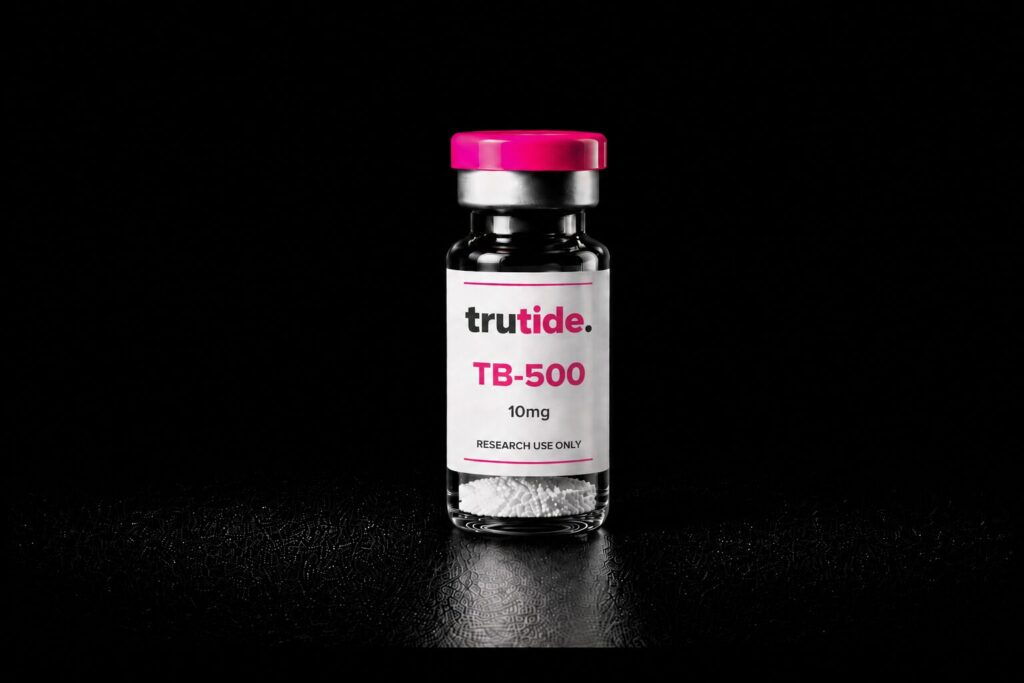
TB-500 is a synthetic peptide fragment derived from thymosin beta-4 and used in experimental research examining actin-associated processes, cytoskeletal organisation, cellular migration and related signalling mechanisms. This article summarises published laboratory and preclinical literature concerning the fragment and its relationship to the parent thymosin beta-4 molecule.
Quick reference
| Property | Value |
|---|---|
| Compound class | Synthetic actin-binding peptide fragment |
| Sequence | Ac-Lys-Leu-Lys-Lys-Thr-Glu-Thr-Gln (8 amino acids, N-terminally acetylated) |
| Source sequence | Residues 17–23 of full-length Thymosin β-4 |
| Molecular formula | C₃₇H₆₈N₁₀O₁₃ |
| Molecular weight | 889.04 g/mol |
| CAS number | 77591-33-4 |
| Origin | Synthetic (corresponds to TB-4 residues 17–23) |
| Form | Lyophilised white powder |
| Storage | 2–8°C refrigerated; −20°C for long-term lyophilised storage; protect from light and moisture |
Introduction
TB-500 is a synthetic 8-amino-acid peptide derived from the active site of Thymosin β-4 — a 43-amino-acid intracellular protein found in virtually all mammalian tissues at high concentrations. The TB-500 fragment was developed as a research tool to investigate the specific functions of the actin-binding domain of TB-4, which is responsible for the protein’s most well-characterised biological activity: regulation of the cellular actin cytoskeleton.
The peptide corresponds to amino acid residues 17–23 of TB-4 (sequence Lys-Leu-Lys-Lys-Thr-Glu-Thr-Gln), with an acetylated N-terminus that mirrors the modification present on the parent protein. This short fragment is sufficient to reproduce the actin-sequestration activity of full-length TB-4 in many preclinical research contexts, making it a focused research probe for studying actin-dependent cellular processes.
Although closely related to Thymosin β-4 and frequently described as a TB-4 fragment, TB-500 is not a synonym for TB-4 and the distinction matters in research contexts. The full-length protein has documented activities beyond actin binding — including roles in angiogenesis, inflammatory-signalling modulation, and cellular differentiation — that are only partially reproduced by the shorter fragment.
Mechanism of action
TB-500’s principal documented mechanism is regulation of cellular actin dynamics through actin sequestration. Several secondary mechanisms have been characterised in published research, all of which trace back in some way to the peptide’s interaction with the actin cytoskeleton.
Actin sequestration
Actin exists in cells in two principal forms: monomeric G-actin (globular) and polymeric F-actin (filamentous). The dynamic equilibrium between these two forms is central to cellular shape, motility, division, and response to injury. Cells require a reserve pool of G-actin that can be rapidly mobilised into F-actin when cytoskeletal remodelling is needed — for example, during cell migration toward a wound site.
TB-4 and its active fragment TB-500 are the principal G-actin sequestering proteins in mammalian cells. By binding G-actin in a 1:1 stoichiometry, they maintain the monomeric pool in a state that prevents spontaneous polymerisation while keeping it immediately available for controlled mobilisation when signalling pathways demand it. This sequestration-and-release function is what underlies the peptide’s reported effects on cellular processes that depend on rapid cytoskeletal reorganisation.
Cellular migration
Published studies examine TB-500 and thymosin beta-4 in cellular-migration assays involving endothelial cells, fibroblasts, keratinocytes and other cell types. These experiments measure actin-associated cytoskeletal dynamics, directional movement and related signalling endpoints.
Angiogenesis
Endothelial-cell migration is one component of angiogenesis, and published work has measured tube formation, endothelial migration and vessel-density endpoints in cellular and animal models involving thymosin beta-4 or related fragments.
Effects on inflammatory signalling
Published research on full-length TB-4 has reported effects on inflammatory signalling in multiple cellular and animal models, including modulation of cytokine release and reduced inflammatory cell recruitment. The extent to which the shorter TB-500 fragment reproduces these effects on inflammatory signalling is less well-characterised in the published literature. Some studies suggest the actin-binding region alone is sufficient to produce a subset of these effects; others suggest the full protein is required for the broader inflammatory-signalling profile.
Published research
The TB-500 and broader Thymosin β-4 research literatures overlap substantially, with most foundational mechanistic work conducted on the full-length protein and subsequently applied to the shorter fragment. Researchers should note that preclinical findings do not necessarily translate to human outcomes and should consult the cited sources directly for full study details.
Cellular and tissue-model research
A substantial part of the literature uses skin, muscle, tendon, ligament and corneal experimental models. Reported endpoints include cellular migration, cytoskeletal organisation, endothelial signalling, epithelialisation measurements and matrix-associated responses. These are preclinical observations rather than established therapeutic effects.
Cardiovascular research
Full-length thymosin beta-4 has been studied in cardiovascular experimental systems involving cardiomyocytes, endothelial responses, progenitor-cell mobilisation and vascular remodelling. Research specifically using TB-500 is more limited and should be distinguished from work on the full-length protein.
Ophthalmic research
Published ophthalmic research has examined thymosin beta-4 and related peptides in corneal epithelial and inflammatory experimental systems. Reported endpoints include epithelial migration, inflammatory-cell measurements and other model-specific observations.
Veterinary research
TB-500 has also appeared in equine and other veterinary research using musculoskeletal experimental models. These studies examine cellular migration, matrix-associated and tissue-response endpoints and do not establish a general veterinary use.
Limitations of current evidence
The majority of published research on TB-500 comes from preclinical animal models and in vitro cell culture studies. Human clinical research with the TB-500 fragment specifically is limited; most clinical-stage research has used full-length TB-4 rather than the shorter fragment. Researchers should be careful when extrapolating from TB-4 clinical findings to predicted TB-500 effects, since the two compounds share mechanistic overlap but are not interchangeable.
Research use only. This article is provided for laboratory and scientific reference purposes. Trutide research products are supplied strictly for in vitro laboratory research and are not for human or veterinary use, clinical use, self-administration, diagnosis, treatment or prevention of disease.
References
- Goldstein AL, Hannappel E, Sosne G, Kleinman HK. Thymosin β4: a multi-functional regenerative peptide. Basic properties and clinical applications. Expert Opinion on Biological Therapy. 2012;12(1):37-51. doi:10.1517/14712598.2012.634793
- Sosne G, Qiu P, Goldstein AL, Wheater M. Biological activities of thymosin β4 defined by active sites in short peptide sequences. The FASEB Journal. 2010;24(7):2144-2151. doi:10.1096/fj.09-142307
- Crockford D, Turjman N, Allan C, Angel J. Thymosin beta4: structure, function, and biological properties supporting current and future clinical applications. Annals of the New York Academy of Sciences. 2010;1194:179-189. doi:10.1111/j.1749-6632.2010.05492.x
- Smart N, Risebro CA, Melville AA, et al. Thymosin β4 induces adult epicardial progenitor mobilization and neovascularization. Nature. 2007;445(7124):177-182. doi:10.1038/nature05383
- Philp D, Goldstein AL, Kleinman HK. Thymosin β4 promotes angiogenesis, wound healing, and hair follicle development. Mechanisms of Ageing and Development. 2004;125(2):113-115. doi:10.1016/j.mad.2003.11.005
- Safer D, Elzinga M, Nachmias VT. Thymosin β4 and Fx, an actin-sequestering peptide, are indistinguishable. Journal of Biological Chemistry. 1991;266(7):4029-4032.
Last updated: 4 June 2026