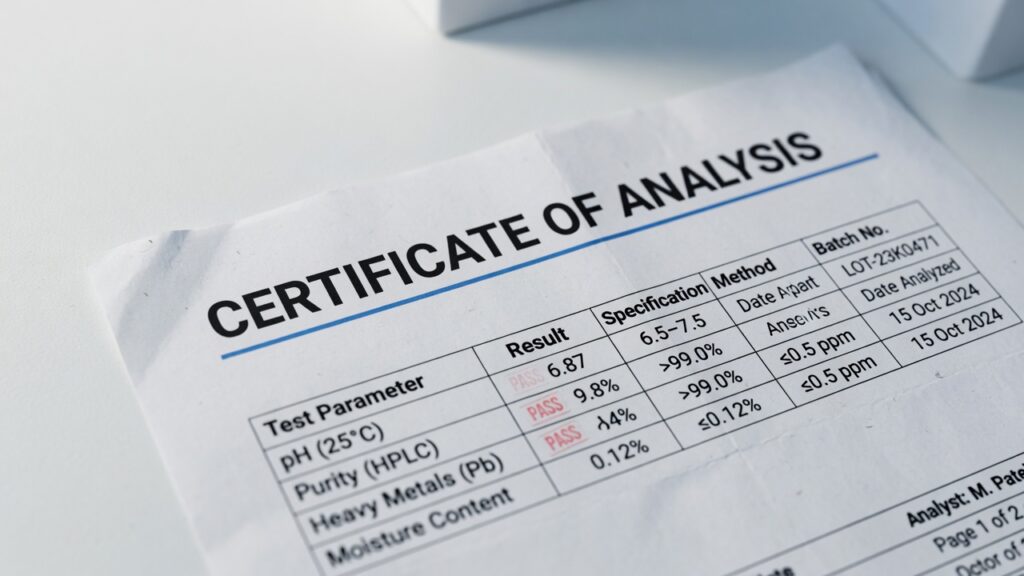
What is a Certificate of Analysis?
A Certificate of Analysis (COA) is a document issued by a testing laboratory or supplier that records analytical results for a specified sample or batch. Depending on the methods used, it may report characteristics such as chromatographic purity, measured mass, composition, appearance or net content.
What information does a COA contain?
A comprehensive COA for a research peptide will typically include:
- Compound name and sequence — the full name and amino acid sequence of the peptide
- Batch or lot number — a unique identifier linking the document to a specific production batch
- Molecular formula and molecular weight — the theoretical values for the compound
- HPLC purity result — the measured purity as a percentage, along with the chromatogram
- Mass spectrometry result — the measured molecular mass, which can be compared with the expected theoretical value as part of identity assessment, along with the spectrum
- Appearance — a description of the physical state of the material (e.g. white lyophilised powder)
- Net weight — the quantity of material in the vial
- Testing laboratory details — the name and accreditation of the laboratory that performed the analysis
- Date of analysis — when the testing was performed
Why is a COA important?
For researchers, a COA provides a traceable record of the analytical tests performed on a specified sample or batch. The value of a COA depends on the methods used, the sampling approach and the strength of the link between the tested sample and the material being supplied.
Third-party versus in-house COAs
Independent third-party testing can provide additional separation between the commercial supplier and the laboratory reporting the analytical result. Researchers should still review the methods, sample identification and scope of each certificate rather than relying on the document label alone.
How to read an HPLC chromatogram on a COA
The HPLC chromatogram shown on a COA is a graph of detector signal (y-axis) versus time (x-axis). The target peptide appears as the largest peak. Purity is calculated as the percentage of the total peak area represented by the target peak. A high-purity peptide will show a single dominant peak with minimal smaller peaks representing impurities. The retention time of the target peak should be consistent with the expected value for that compound.
Verifying a COA
Some testing laboratories offer online verification tools that allow researchers to confirm the authenticity of a COA using a unique verification code. This provides an additional layer of assurance that the document has not been altered. Janoshik, the independent laboratory used by Trutide, provides a public verification portal at janoshik.com where COA results can be independently confirmed.
For a field-by-field walkthrough of an actual certificate, see our guide on how to read a Janoshik COA. For the framework these products are supplied under, see what does Research Use Only mean.
Research use only. This article is provided for laboratory and scientific reference purposes. Trutide research products are supplied strictly for in vitro laboratory research and are not for human or veterinary use, clinical use, self-administration, diagnosis, treatment or prevention of disease.