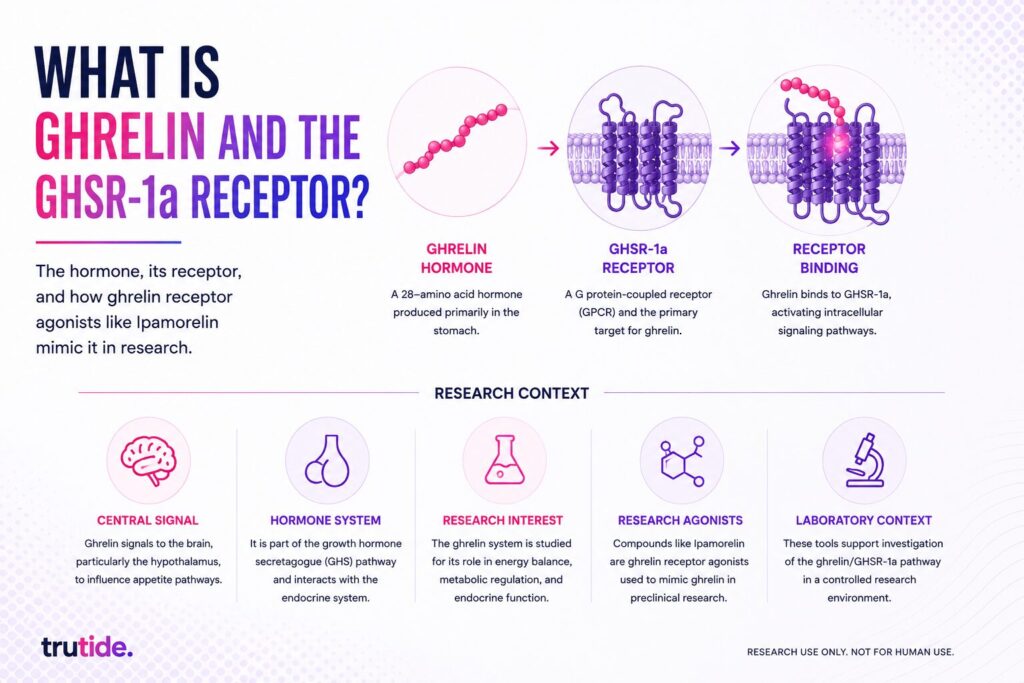
Ghrelin is a hormone best known for its role in appetite signalling, but in the context of peptide research it matters for a different reason: it is the natural ligand of the growth hormone secretagogue receptor (GHSR-1a), the receptor that ghrelin receptor agonists such as Ipamorelin act upon. Understanding ghrelin and its receptor is the key to understanding one of the two main classes of growth hormone secretagogue, and therefore one half of the rationale behind compounds like the CJC-1295 and Ipamorelin blend. This guide explains what ghrelin is, how the GHSR-1a receptor works, ghrelin’s documented roles, and how synthetic ghrelin receptor agonists mimic it in research.
Ghrelin and GHSR-1a at a glance
| Property | Detail |
|---|---|
| Ghrelin | Peptide hormone, primarily produced in the stomach |
| Receptor | GHSR-1a (growth hormone secretagogue receptor type 1a) |
| Receptor signalling | Gαq → phospholipase C → IP₃ pathway |
| Documented roles | Growth hormone release, appetite signalling, energy balance |
| Distinctive feature | Requires acylation (a fatty acid modification) to activate the receptor |
| Synthetic agonists | Ipamorelin, GHRP-2, GHRP-6, Hexarelin |
What ghrelin is
Ghrelin is a peptide hormone produced primarily by cells in the stomach lining. It is widely known as the “hunger hormone” because of its role in stimulating appetite, but its biological functions extend well beyond appetite — and in the context of growth hormone research, its most relevant property is its powerful ability to stimulate growth hormone release.
Ghrelin was identified as the natural ligand of a receptor that had been known about before the hormone itself was found. Researchers had identified a receptor that responded to certain synthetic growth-hormone-releasing compounds — the “growth hormone secretagogue receptor” — but the body’s own molecule that activated it was unknown. Ghrelin turned out to be that endogenous ligand, which is why the receptor and the hormone are so closely linked in research.
The GHSR-1a receptor
The growth hormone secretagogue receptor type 1a (GHSR-1a) is the receptor through which ghrelin and synthetic ghrelin receptor agonists exert their effects on growth hormone release. It is a G protein-coupled receptor, found in the pituitary and hypothalamus among other sites.
Signalling pathway
GHSR-1a couples primarily to the Gαq–phospholipase C–IP₃ signalling pathway. This is a different intracellular route from the one used by the GHRH receptor (which acts through the Gαs–cAMP pathway). The distinction matters because it is the basis for combining the two classes of growth hormone secretagogue: stimulating two receptors that act through two independent pathways produces a greater combined effect on growth hormone release than stimulating either alone.
The acylation requirement
A distinctive feature of ghrelin biology is that the hormone requires a specific chemical modification — acylation with a fatty acid on a particular serine residue — to activate the GHSR-1a receptor. Unacylated ghrelin does not activate the receptor in the same way. This acylation requirement is a notable feature of the natural hormone, though synthetic ghrelin receptor agonists are designed around the receptor’s activation requirements in their own ways.
Ghrelin’s documented roles
Ghrelin has several documented roles in published research:
- Growth hormone release — ghrelin is a potent stimulator of growth hormone secretion via GHSR-1a, the property most relevant to growth hormone research.
- Appetite signalling — ghrelin stimulates appetite and is involved in the regulation of food intake, the role that earned it the “hunger hormone” label.
- Energy balance — ghrelin participates in the broader regulation of energy homeostasis and metabolism.
In growth hormone secretagogue research, it is the first of these — the stimulation of growth hormone release — that is the focus, and the basis for developing synthetic agonists of the ghrelin receptor.
Synthetic ghrelin receptor agonists
Ghrelin receptor agonists — also called growth hormone-releasing peptides (GHRPs) — are synthetic compounds that activate GHSR-1a to stimulate growth hormone release, mimicking ghrelin’s action at the receptor. This class includes GHRP-2, GHRP-6, Hexarelin, and Ipamorelin.
They differ mainly in selectivity. Earlier-generation compounds such as GHRP-6 and GHRP-2 stimulate growth hormone release effectively but also produce off-target effects — GHRP-6 is notably associated with strong appetite stimulation (consistent with ghrelin’s appetite role), and several earlier compounds influence cortisol and prolactin. Ipamorelin was developed as a more selective ghrelin receptor agonist, characterised in published research as stimulating growth hormone release with minimal reported effect on cortisol and prolactin. This selectivity is why Ipamorelin is the ghrelin agonist most commonly used in modern research blends.
For the wider class context — including how ghrelin receptor agonists are combined with GHRH analogues — see our guide on growth hormone secretagogues.
Frequently asked questions
What is ghrelin?
Ghrelin is a peptide hormone produced primarily in the stomach. It is known as the “hunger hormone” for its role in appetite, but it is also a potent stimulator of growth hormone release. It is the natural ligand of the GHSR-1a receptor.
What is the GHSR-1a receptor?
GHSR-1a is the growth hormone secretagogue receptor type 1a — the G protein-coupled receptor that ghrelin and synthetic ghrelin receptor agonists act upon to stimulate growth hormone release. It signals primarily through the Gαq–phospholipase C–IP₃ pathway.
How does the GHSR-1a pathway differ from the GHRH pathway?
GHSR-1a signals through the Gαq–phospholipase C pathway, while the GHRH receptor signals through the Gαs–cAMP pathway. These are independent intracellular routes, which is the basis for combining a ghrelin receptor agonist with a GHRH analogue — two pathways converging on growth hormone release produce a greater combined effect.
What are ghrelin receptor agonists?
They are synthetic compounds that activate the GHSR-1a receptor to stimulate growth hormone release, mimicking ghrelin. Also called growth hormone-releasing peptides (GHRPs), the class includes Ipamorelin, GHRP-2, GHRP-6, and Hexarelin. Ipamorelin is the most selective and the most commonly used in research blends.
Why is Ipamorelin preferred among ghrelin receptor agonists?
Ipamorelin is more selective than earlier ghrelin agonists. It stimulates growth hormone release with minimal reported effect on cortisol and prolactin, and without the strong appetite stimulation associated with GHRP-6. This selectivity makes it the preferred ghrelin receptor agonist in modern research blends.
Can ghrelin receptor agonists be used in humans?
No. Trutide research products are supplied strictly for in vitro laboratory and scientific research. They are not for human or veterinary use, clinical use, self-administration, diagnosis, treatment or prevention of disease.
Further reading
For the wider class context, see our guide on growth hormone secretagogues. For the GHRH-analogue half of the combination and the leading research blend, see our CJC-1295 & Ipamorelin research guide and the explainer on CJC-1295 DAC vs no DAC.
Research use only. This article is provided for laboratory and scientific reference purposes. Trutide research products are supplied strictly for in vitro laboratory research and are not for human or veterinary use, clinical use, self-administration, diagnosis, treatment or prevention of disease.
References
- Kojima M, Hosoda H, Date Y, et al. Ghrelin is a growth-hormone-releasing acylated peptide from stomach. Nature. 1999;402(6762):656-660. doi:10.1038/45230
- Raun K, Hansen BS, Johansen NL, et al. Ipamorelin, the first selective growth hormone secretagogue. European Journal of Endocrinology. 1998;139(5):552-561. doi:10.1530/eje.0.1390552
- Howard AD, Feighner SD, Cully DF, et al. A receptor in pituitary and hypothalamus that functions in growth hormone release. Science. 1996;273(5277):974-977. doi:10.1126/science.273.5277.974
- Müller TD, Nogueiras R, Andermann ML, et al. Ghrelin. Molecular Metabolism. 2015;4(6):437-460. doi:10.1016/j.molmet.2015.03.005
- Bowers CY. Growth hormone-releasing peptide (GHRP). Cellular and Molecular Life Sciences. 1998;54(12):1316-1329. doi:10.1007/s000180050257
Last updated: 16 June 2026