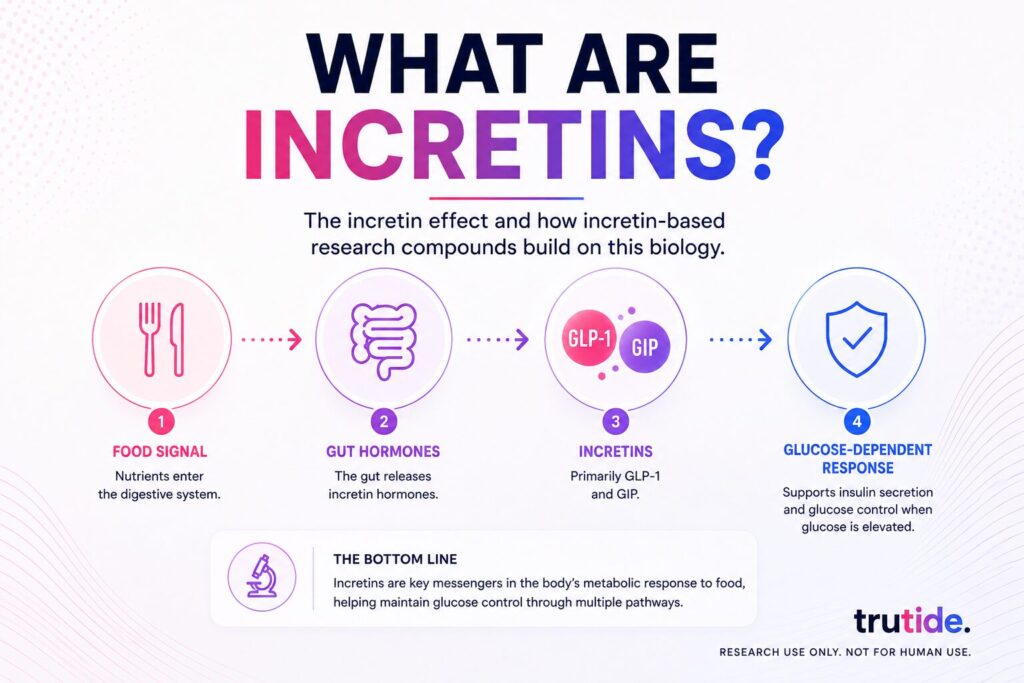
Incretins are hormones released from the gut in response to food that regulate blood glucose, primarily by stimulating insulin secretion. They are the biological foundation of one of the most active areas of metabolic research — the incretin-based compounds that include GLP-1 receptor agonists and the more recent dual and triple agonists. Understanding incretins is the starting point for understanding that entire class of research compounds, because every one of them works by mimicking or building upon incretin biology. This guide explains what incretins are, the “incretin effect,” the two principal incretin hormones (GLP-1 and GIP), why their activity is glucose-dependent, and how incretin-based research compounds are built on this foundation.
Incretins at a glance
| Property | Detail |
|---|---|
| What they are | Gut-derived hormones that regulate blood glucose |
| Released in response to | Food intake (nutrients entering the gut) |
| Principal incretins | GLP-1 and GIP |
| Main action | Glucose-dependent stimulation of insulin secretion |
| The incretin effect | Oral glucose produces more insulin than IV glucose |
| Degraded by | Dipeptidyl peptidase-4 (DPP-4) |
| Research relevance | Foundation of GLP-1, dual, and triple agonists |
What incretins are
Incretins are a group of metabolic hormones produced in the gut and released into the bloodstream when food is consumed. Their primary role is to help regulate blood glucose levels following a meal, principally by signalling the pancreas to release insulin. The name “incretin” derives from “intestine secretion insulin” — reflecting their origin in the gut and their action on insulin.
They are part of the body’s anticipatory response to eating. When nutrients enter the digestive tract, specialised cells in the intestinal lining release incretin hormones, which then prepare the body to handle the incoming glucose load. This gut-to-pancreas signalling is a key part of normal glucose regulation and is the biological system that incretin-based research compounds are designed to engage.
The incretin effect
The “incretin effect” is the phenomenon that first revealed the importance of these hormones. Researchers observed that a given amount of glucose taken orally produces a substantially larger insulin response than the same amount of glucose delivered intravenously. The difference is striking — a significant portion of the insulin response to a meal is attributable to incretins rather than to the glucose itself.
The explanation is that oral glucose passes through the gut, triggering incretin release, while intravenous glucose bypasses the gut entirely and triggers no incretin response. The gap between the two insulin responses is the incretin effect, and it demonstrated that the gut plays an active hormonal role in glucose regulation — not merely a passive absorptive one. This discovery is what drove research interest in identifying and ultimately mimicking the incretin hormones.
The two principal incretins
Two hormones account for the great majority of the incretin effect: GLP-1 and GIP.
GLP-1 (glucagon-like peptide-1)
GLP-1 is released from L-cells in the intestinal lining. Beyond stimulating glucose-dependent insulin secretion, it suppresses glucagon release, slows gastric emptying, and acts on appetite-signalling pathways in the central nervous system. Its breadth of action made it the first incretin pathway to be developed into receptor agonists. For detail, see our guide on GLP-1 receptor agonists.
GIP (glucose-dependent insulinotropic polypeptide)
GIP is released from K-cells in the intestinal lining. Like GLP-1, it stimulates glucose-dependent insulin secretion, but it also has distinct documented roles in lipid metabolism and adipose tissue signalling that GLP-1 does not replicate. Historically it received less research attention than GLP-1, but it has become central to the dual-agonist approach.
Why incretin action is glucose-dependent
A defining feature of incretin biology is that the insulin-stimulating effect is glucose-dependent. Incretins enhance insulin secretion when blood glucose is elevated, and the effect diminishes as glucose returns toward normal levels. They do not force insulin release regardless of glucose — they amplify the glucose-driven response.
This built-in self-regulation is one of the most significant features of the incretin system from a research perspective. It means incretin-based signalling is responsive to context rather than constant, a property that distinguishes it from mechanisms that stimulate insulin release unconditionally. This glucose-dependence carries through to the research compounds built on incretin biology.
DPP-4 and the half-life problem
Native incretins have a very short working life. Both GLP-1 and GIP are rapidly degraded by an enzyme called dipeptidyl peptidase-4 (DPP-4), which cleaves and inactivates them within minutes of release. Native GLP-1, for example, has a half-life of only about 1–2 minutes.
This rapid degradation is the central challenge in turning incretin biology into a usable research tool. The natural hormones disappear almost immediately, so synthetic incretin receptor agonists are engineered to resist DPP-4 — through amino acid substitutions at the cleavage site, and through fatty acid acylation that binds the peptide to albumin and extends its half-life to days. These modifications are what make modern incretin-based compounds practical for research.
How research compounds build on incretins
The incretin system is the foundation of an entire class of research compounds, built up in stages:
- GLP-1 receptor agonists — the single-target starting point, activating the GLP-1 receptor. See GLP-1 receptor agonists.
- Dual agonists — adding the GIP receptor to GLP-1, engaging both incretin pathways. Tirzepatide is the leading example. See GLP-1 and GIP dual agonists.
- Triple agonists — add a third receptor target on top of GLP-1 and GIP, extending the multi-receptor research model beyond the two incretins.
Each stage builds on the incretin foundation rather than replacing it — the incretin activity remains the common base across all of them. This is why understanding incretins is the natural entry point to the whole cluster.
Frequently asked questions
What are incretins?
Incretins are hormones released from the gut in response to food that regulate blood glucose, primarily by stimulating glucose-dependent insulin secretion. The two principal incretins are GLP-1 and GIP. They are the biological foundation of incretin-based research compounds.
What is the incretin effect?
The incretin effect is the observation that oral glucose produces a substantially larger insulin response than the same amount of glucose given intravenously. The difference is due to incretin hormones released when glucose passes through the gut — a route bypassed by intravenous delivery.
What are the two main incretins?
GLP-1 (glucagon-like peptide-1), released from intestinal L-cells, and GIP (glucose-dependent insulinotropic polypeptide), released from intestinal K-cells. Both stimulate glucose-dependent insulin secretion; GLP-1 also suppresses glucagon and slows gastric emptying, while GIP has additional roles in lipid metabolism.
What does “glucose-dependent” mean for incretins?
It means their insulin-stimulating effect depends on blood glucose being elevated. Incretins amplify insulin secretion when glucose is high, and the effect diminishes as glucose normalises — a built-in self-regulation rather than unconditional insulin stimulation.
Why are incretin research compounds engineered to resist DPP-4?
Native incretins are degraded by the enzyme DPP-4 within minutes (native GLP-1 has a ~1–2 minute half-life). To be usable research tools, synthetic incretin agonists are engineered — through amino acid substitutions and fatty acid acylation — to resist this degradation and act over days rather than minutes.
How do incretins relate to dual and triple agonists?
Incretin-based research models can progress from single GLP-1 receptor agonism to dual GLP-1/GIP agonism and then to experimental multi-receptor systems that add a third receptor target.
Further reading
Research use only. This article is provided for laboratory and scientific reference purposes. Trutide research products are supplied strictly for in vitro laboratory research and are not for human or veterinary use, clinical use, self-administration, diagnosis, treatment or prevention of disease.
References
- Nauck MA, Meier JJ. Incretin hormones: their role in health and disease. Diabetes, Obesity and Metabolism. 2018;20(Suppl 1):5-21. doi:10.1111/dom.13129
- Baggio LL, Drucker DJ. Biology of incretins: GLP-1 and GIP. Gastroenterology. 2007;132(6):2131-2157. doi:10.1053/j.gastro.2007.03.054
- Nauck MA, Homberger E, Siegel EG, et al. Incretin effects of increasing glucose loads in man calculated from venous insulin and C-peptide responses. The Journal of Clinical Endocrinology & Metabolism. 1986;63(2):492-498. doi:10.1210/jcem-63-2-492
- Drucker DJ, Nauck MA. The incretin system: glucagon-like peptide-1 receptor agonists and dipeptidyl peptidase-4 inhibitors in type 2 diabetes. The Lancet. 2006;368(9548):1696-1705. doi:10.1016/S0140-6736(06)69705-5
- Holst JJ. The physiology of glucagon-like peptide 1. Physiological Reviews. 2007;87(4):1409-1439. doi:10.1152/physrev.00034.2006
Last updated: 14 June 2026