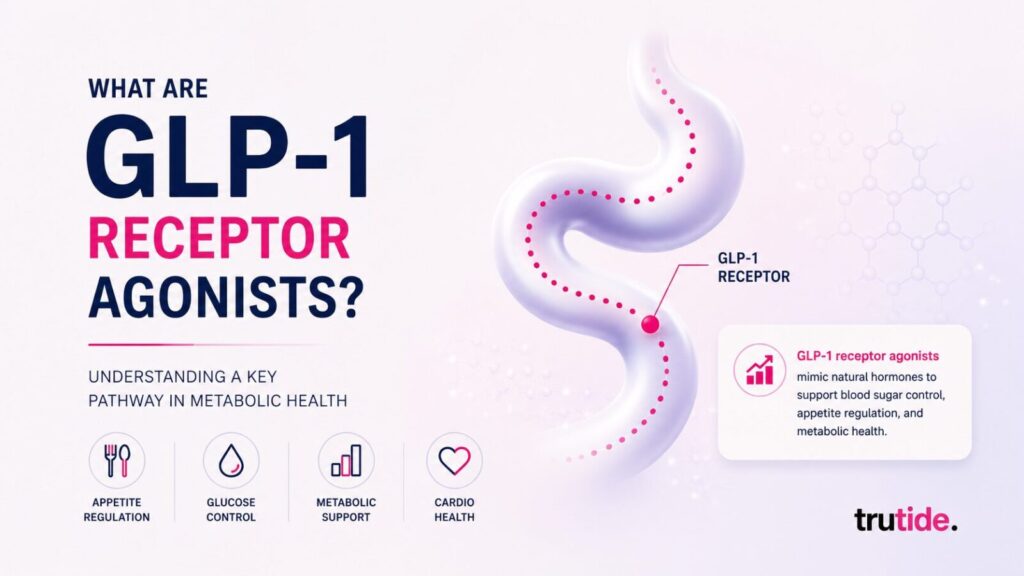
GLP-1 receptor agonists are compounds that activate the glucagon-like peptide-1 (GLP-1) receptor, mimicking the action of one of the body’s own incretin hormones. They are the foundation of the entire incretin-based class of metabolic compounds — the single-target starting point from which the more recent dual and triple agonists were developed. GLP-1 is a gut-derived hormone that regulates insulin secretion, glucagon release, gastric emptying, and appetite signalling, and synthetic agonists are engineered to reproduce its effects while resisting the rapid degradation that limits the natural hormone. This guide explains what GLP-1 is, how the receptor works, what GLP-1 receptor agonists do, and how they relate to the dual and triple agonists built on the same foundation.
GLP-1 at a glance
| Property | Detail |
|---|---|
| Full name | Glucagon-like peptide-1 |
| Class | Incretin hormone |
| Released from | Intestinal L-cells in response to food |
| Receptor | GLP-1 receptor (GLP-1R), a G protein-coupled receptor |
| Documented effects | Glucose-dependent insulin secretion, glucagon suppression, slowed gastric emptying, appetite signalling |
| Natural half-life | ~1–2 minutes (degraded by DPP-4) |
| Agonist design goal | Reproduce GLP-1 activity with resistance to DPP-4 degradation |
What GLP-1 is
Glucagon-like peptide-1 (GLP-1) is an incretin — a hormone released from the gut in response to food intake that regulates blood glucose. It is secreted by specialised L-cells in the intestinal lining and is one of the two principal incretin hormones, alongside glucose-dependent insulinotropic polypeptide (GIP).
GLP-1 is part of the body’s response to eating. When food enters the gut, L-cells release GLP-1, which signals the pancreas to prepare for the incoming glucose load. Its central characteristic — shared across the incretin class — is that its insulin-stimulating effect is glucose-dependent: it enhances insulin secretion when blood glucose is elevated, and the effect diminishes as glucose returns toward normal. This built-in self-regulation is one of the features that makes the GLP-1 pathway of such interest in metabolic research.
What the GLP-1 receptor does
The GLP-1 receptor (GLP-1R) is a G protein-coupled receptor found in the pancreas and a number of other tissues, including the central nervous system, stomach, and heart. When GLP-1 — or a GLP-1 receptor agonist — binds the receptor, it triggers a cascade of downstream effects. The receptor’s broad tissue distribution is why GLP-1 has such a wide range of documented actions.
The principal documented effects of GLP-1 receptor activation are:
- Glucose-dependent insulin secretion — stimulating insulin release from pancreatic beta-cells when glucose is elevated
- Glucagon suppression — reducing the release of glucagon, the hormone that raises blood glucose
- Slowed gastric emptying — delaying the rate at which the stomach empties, which moderates the post-meal glucose rise
- Appetite signalling — acting on central nervous system pathways involved in satiety
The combination of these effects on a single receptor is what made GLP-1 the first incretin pathway to be developed into receptor agonists, and the foundation of the broader incretin class.
Why agonists are engineered for stability
Native GLP-1 has a very short half-life — approximately 1 to 2 minutes — because it is rapidly degraded by the enzyme dipeptidyl peptidase-4 (DPP-4). This makes the natural hormone impractical as a research or therapeutic tool, since it disappears almost immediately.
Synthetic GLP-1 receptor agonists are therefore engineered to resist this degradation and extend their duration of action. The strategies used include amino acid substitutions at the DPP-4 cleavage site (preventing the enzyme from cutting the peptide) and fatty acid acylation (attaching a lipid chain that binds albumin, protecting the peptide from clearance and extending its half-life). These modifications are what allow modern GLP-1 receptor agonists to act over days rather than minutes, supporting infrequent administration in research protocols. The same acylation strategy is used in the dual and triple agonists that followed.
From single to dual and triple agonists
The GLP-1 receptor agonist is the foundation of the incretin class, and the more recent multi-receptor agonists were built directly on it by adding further receptor targets.
- GLP-1 receptor agonists — the single-target foundation, activating the GLP-1 receptor alone.
- Dual agonists — add the GIP receptor to GLP-1, engaging both incretin pathways. Tirzepatide is the leading example. See our guide on GLP-1 and GIP dual agonists.
- Triple agonists — add a third receptor target, such as the glucagon receptor, on top of GLP-1 and GIP to create a multi-receptor research system.
Each step adds a receptor rather than replacing one — the GLP-1 activity remains the common foundation across all three classes. Understanding the GLP-1 receptor is therefore the starting point for understanding the whole incretin-agonist family.
Frequently asked questions
What is a GLP-1 receptor agonist?
A GLP-1 receptor agonist is a compound that activates the GLP-1 receptor, mimicking the action of the natural incretin hormone glucagon-like peptide-1. It reproduces GLP-1’s effects — glucose-dependent insulin secretion, glucagon suppression, slowed gastric emptying, and appetite signalling — while being engineered to resist the rapid degradation that limits the natural hormone.
What does GLP-1 do?
GLP-1 is an incretin hormone released from the gut after eating. It stimulates glucose-dependent insulin secretion, suppresses glucagon, slows gastric emptying, and acts on appetite-signalling pathways in the central nervous system. Its insulin effect is glucose-dependent, meaning it works when glucose is high and tapers as glucose normalises.
Why is native GLP-1 not used directly?
Native GLP-1 has a half-life of only about 1–2 minutes because it is rapidly degraded by the enzyme DPP-4. This makes the natural hormone impractical. Synthetic agonists are engineered — through amino acid substitutions and fatty acid acylation — to resist degradation and act over a much longer period.
How do GLP-1 agonists relate to dual and triple agonists?
GLP-1 receptor agonists provide the single-target foundation. Dual agonists add a second receptor such as GIP, while triple-agonist research extends the concept to a third receptor target.
What does “glucose-dependent” mean?
It means the insulin-stimulating effect depends on blood glucose being elevated. GLP-1 enhances insulin secretion when glucose is high and the effect diminishes as glucose returns toward normal — a built-in self-regulation characteristic of incretin hormones.
Can GLP-1 receptor agonists be used in humans?
No. Trutide research products are supplied strictly for in vitro laboratory and scientific research. They are not for human or veterinary use, clinical use, self-administration, diagnosis, treatment or prevention of disease.
Further reading
Research use only. This article is provided for laboratory and scientific reference purposes. Trutide research products are supplied strictly for in vitro laboratory research and are not for human or veterinary use, clinical use, self-administration, diagnosis, treatment or prevention of disease.
References
- Baggio LL, Drucker DJ. Biology of incretins: GLP-1 and GIP. Gastroenterology. 2007;132(6):2131-2157. doi:10.1053/j.gastro.2007.03.054
- Drucker DJ. Mechanisms of action and therapeutic application of glucagon-like peptide-1. Cell Metabolism. 2018;27(4):740-756. doi:10.1016/j.cmet.2018.03.001
- Nauck MA, Meier JJ. Incretin hormones: their role in health and disease. Diabetes, Obesity and Metabolism. 2018;20(Suppl 1):5-21. doi:10.1111/dom.13129
- Holst JJ. The physiology of glucagon-like peptide 1. Physiological Reviews. 2007;87(4):1409-1439. doi:10.1152/physrev.00034.2006
- Müller TD, Finan B, Bloom SR, et al. Glucagon-like peptide 1 (GLP-1). Molecular Metabolism. 2019;30:72-130. doi:10.1016/j.molmet.2019.09.010
Last updated: 8 June 2026