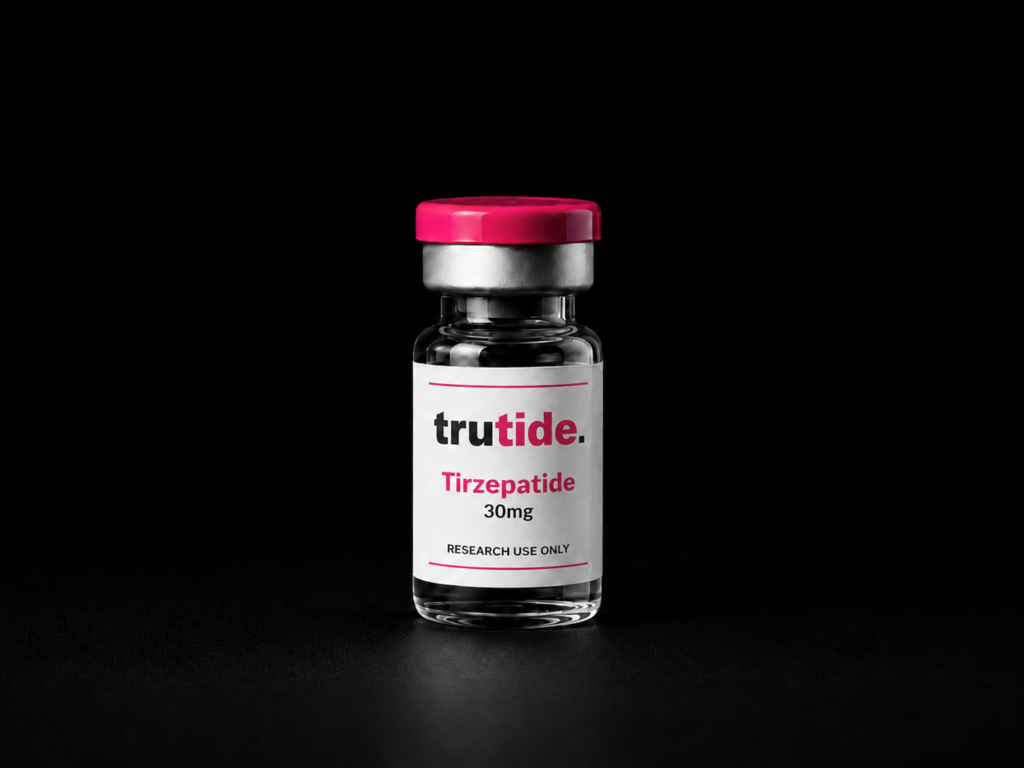
Tirzepatide has rapidly become one of the most-studied research peptides of recent years. As the first dual incretin receptor agonist — simultaneously activating both the GIP and GLP-1 receptors — it occupies a distinct position in metabolic and energy homeostasis research, with a growing body of peer-reviewed literature examining its pharmacology, pharmacokinetics, and downstream effects. This guide is a working reference for laboratory researchers: structure and specifications, mechanism of action, key published studies, handling protocols, and quality considerations when sourcing research-grade material.
Quick reference
| Property | Value |
|---|---|
| Drug class | Dual GIP/GLP-1 receptor agonist |
| Molecular formula | C₂₂₅H₃₄₈N₄₈O₆₈ |
| Molecular weight | 4813.53 g/mol |
| CAS number | 2023788-19-2 |
| Amino acid length | 39 (with C20 fatty diacid modification) |
| Half-life (research) | ~5 days in published pharmacokinetic studies |
| Form | Lyophilised white to off-white powder |
| Solubility | Soluble in bacteriostatic water after reconstitution |
| Storage | −20°C, protected from light and moisture |
Trutide supplies research-grade tirzepatide at ≥98% HPLC purity, independently tested by Janoshik Analytical. View product details →
Introduction
Tirzepatide is a synthetic 39-amino acid linear peptide that has attracted significant research interest as the first dual incretin receptor agonist developed for metabolic research. It simultaneously activates two distinct receptors — the glucose-dependent insulinotropic polypeptide (GIP) receptor and the glucagon-like peptide-1 (GLP-1) receptor — making it pharmacologically distinct from earlier mono-agonist peptides in the same therapeutic class.
The compound’s structure incorporates a C20 fatty diacid modification that enhances albumin binding and prolongs its half-life in experimental models. This structural feature allows for once-weekly dosing protocols in clinical research settings, a property that has driven extensive investigation across multiple research domains including glucose metabolism, energy homeostasis, and incretin signalling pathways.
This research guide provides a comprehensive reference for laboratory researchers working with tirzepatide. It covers the compound’s mechanism of action, published research findings, pharmacokinetic profile, handling requirements, and quality considerations relevant to in vitro and preclinical investigation.
Mechanism of action
Tirzepatide’s pharmacological profile derives from its dual receptor activity at the GIP and GLP-1 receptors, both of which belong to the class B family of G protein-coupled receptors (GPCRs). Understanding the distinct contributions of each receptor is foundational to interpreting research findings involving the compound.
GIP receptor activation
The glucose-dependent insulinotropic polypeptide receptor is expressed primarily on pancreatic beta cells, adipocytes, and various tissues involved in energy regulation. In published research, GIP receptor activation has been associated with glucose-dependent insulin secretion, modulation of lipid metabolism, and effects on adipocyte function.
Tirzepatide demonstrates strong agonist activity at the GIP receptor in published binding studies, with binding affinity comparable to native GIP itself. The compound’s GIP receptor engagement is considered a key differentiator from earlier mono-agonist peptides that target only GLP-1.
GLP-1 receptor activation
The glucagon-like peptide-1 receptor is widely expressed on pancreatic beta cells, in the central nervous system (particularly the hypothalamus and brainstem), and in gastrointestinal tissues. Research on GLP-1 receptor signalling has shown effects on glucose-stimulated insulin secretion, gastric emptying, satiety signalling, and central appetite regulation.
Tirzepatide acts as a GLP-1 receptor agonist with binding affinity somewhat lower than native GLP-1, but with markedly extended duration of action due to its structural modifications.
Downstream signalling
Both receptors couple primarily to the Gαs subunit, leading to activation of adenylate cyclase and increased intracellular cyclic adenosine monophosphate (cAMP). Research has shown this signalling cascade drives downstream effects on insulin gene transcription, glucose-stimulated insulin secretion, and various metabolic pathways.
The dual activation profile of tirzepatide produces effects that published research has reported as distinct from those produced by activation of either receptor alone, suggesting potential synergistic or complementary pharmacological interactions between the two signalling pathways.
Published research
Tirzepatide has been the subject of extensive published research across multiple investigation areas. This section summarises key findings from peer-reviewed literature available at the time of writing. Researchers should consult the cited sources directly for full study details.
Metabolic research
The SURPASS programme of clinical trials investigated tirzepatide’s effects on glucose regulation in metabolic disease research contexts. The SURPASS-1 study (Rosenstock et al., 2021, published in The Lancet) examined glycaemic effects in research participants with type 2 diabetes, reporting significant reductions in HbA1c versus placebo across multiple dosing levels (Rosenstock et al., 2021, doi:10.1016/S0140-6736(21)01324-6).
The SURPASS-2 study (Frías et al., 2021, New England Journal of Medicine) compared tirzepatide to semaglutide in research subjects, providing head-to-head data on glucose-lowering efficacy between the dual agonist and the GLP-1 mono-agonist comparator (Frías et al., 2021, doi:10.1056/NEJMoa2107519).
Energy balance research
The SURMOUNT programme investigated tirzepatide’s effects on body weight in research contexts. SURMOUNT-1 (Jastreboff et al., 2022, New England Journal of Medicine) examined weight changes in adult research participants without diabetes, reporting dose-dependent reductions in body weight across the 5mg, 10mg, and 15mg weekly dosing arms over a 72-week period (Jastreboff et al., 2022, doi:10.1056/NEJMoa2206038).
Subsequent SURMOUNT studies extended this research to participants with type 2 diabetes (SURMOUNT-2), participants with prior weight reduction (SURMOUNT-3), and longer-term maintenance contexts (SURMOUNT-4), providing a comprehensive body of evidence on the compound’s effects on energy balance parameters.
Incretin pathway research
Beyond efficacy studies, tirzepatide has been used as a research tool to investigate incretin biology. Studies examining the relative contributions of GIP versus GLP-1 receptor activation have leveraged the compound’s dual activity to explore questions about receptor crosstalk, beta cell biology, and the role of incretins in energy homeostasis.
Research published in Cell Metabolism and other peer-reviewed journals has investigated the molecular basis of tirzepatide’s distinct pharmacology, including studies of biased signalling at the GLP-1 receptor that may explain some of the compound’s observed effects compared to native GLP-1 or other agonists.
Cardiovascular research
Cardiovascular outcomes research has examined effects of tirzepatide on parameters relevant to cardiovascular risk in metabolic research contexts. The SURPASS-CVOT trial is examining major cardiovascular outcomes in research subjects with type 2 diabetes and established atherosclerotic cardiovascular disease.
Published research has reported effects on lipid parameters, blood pressure, and various biomarkers of cardiovascular risk in shorter-term studies, though full cardiovascular outcomes data remains under investigation.
Pharmacokinetics
The pharmacokinetic profile of tirzepatide is central to its experimental properties and dosing protocols in research contexts.
Absorption
Following subcutaneous administration in published research, tirzepatide reaches maximum plasma concentrations approximately 24 to 72 hours post-administration. Bioavailability is reported as approximately 80% in pharmacokinetic studies.
Distribution
Tirzepatide’s fatty acid modification produces extensive albumin binding (>99%) in published research, which contributes substantially to its prolonged plasma half-life and steady-state distribution profile. Volume of distribution at steady state is reported as approximately 10.3 litres.
Metabolism
The compound is metabolised via proteolytic cleavage of its peptide backbone, beta-oxidation of the C20 fatty diacid moiety, and amide hydrolysis. Research has not identified specific cytochrome P450 enzymes as major contributors to metabolism, suggesting limited potential for cytochrome-mediated drug-drug interactions in research contexts.
Elimination
The terminal half-life of tirzepatide in published pharmacokinetic studies is approximately 5 days, supporting once-weekly dosing protocols in clinical research. Elimination occurs primarily through metabolic clearance rather than renal or hepatic excretion of unchanged compound.
Dosing in research
Published clinical research has used dose-titration protocols starting at 2.5mg weekly with increases at 4-week intervals to 5mg, 7.5mg, 10mg, 12.5mg, and 15mg maximum weekly dose. Researchers should follow their own institutional protocols and study designs when working with the compound.
Handling and storage
Proper handling is critical to preserving tirzepatide’s integrity and ensuring reproducibility in research applications.
Lyophilised storage
Trutide supplies tirzepatide as a lyophilised white to off-white powder in sealed vials. Unopened vials should be stored at −20°C in a dry, dark environment protected from light and moisture. When stored correctly, the lyophilised powder is stable for up to 24-36 months.
Allow vials to equilibrate to room temperature before opening to prevent moisture condensation on the powder, which can compromise stability.
Reconstitution
Tirzepatide is reconstituted using sterile bacteriostatic water (BAC water) containing 0.9% benzyl alcohol as a preservative. The benzyl alcohol extends usable life of the reconstituted solution while inhibiting microbial growth.
Standard reconstitution protocol:
- Allow vials of tirzepatide and BAC water to reach room temperature.
- Add 2-5 mL of BAC water slowly along the side of the vial to achieve the desired concentration (typical research concentrations: 6-15 mg/mL).
- Gently swirl or tilt the vial until the powder is fully dissolved. Do not shake vigorously, as this can cause foaming or peptide degradation.
- Once reconstituted, the solution should be clear and colourless to slightly hazy.
For more detail on reconstitution best practice, see our guide on how to reconstitute research peptides.
Reconstituted storage
Once reconstituted, tirzepatide solutions should be stored at 2-8°C (refrigerated) and used within 28 days. Do not refreeze reconstituted solutions, as freeze-thaw cycles can compromise peptide integrity.
Handling notes
- Always work in a sterile environment using aseptic technique
- Avoid repeated freeze-thaw cycles with the lyophilised powder
- Protect from direct light and excessive heat during experimental procedures
- Discard any unused solution that becomes cloudy or contains visible particulates
- Follow your laboratory’s standard operating procedures for handling research peptides
For comprehensive guidance on peptide storage protocols, see how to store research peptides correctly.
Quality considerations in research
The reliability of research findings using tirzepatide depends substantially on the purity and integrity of the compound used. Research-grade material must meet rigorous analytical standards to ensure reproducibility.
Purity verification
Trutide’s tirzepatide is independently tested at ≥98% purity minimum by HPLC analysis. Every batch undergoes:
- High-performance liquid chromatography (HPLC) to quantify purity by separating the target peptide from synthesis-related impurities, truncated sequences, and degradation products
- Mass spectrometry to confirm sequence identity by matching the measured molecular weight against the theoretical value (4813.53 g/mol)
For a fuller explanation of HPLC purity testing methodology, see our guide on understanding peptide purity.
Certificate of Analysis
Every batch of Trutide tirzepatide is supplied with a batch-specific Certificate of Analysis (COA) documenting:
- HPLC purity percentage
- Mass spectrometry sequence confirmation
- Batch number and synthesis date
- Independent third-party laboratory verification (Janoshik Analytical)
To learn more about what a COA contains and why it matters, see our guide on what is a Certificate of Analysis.
Why purity matters
In peptide research, even small percentages of impurities can confound experimental results. A 95% pure peptide contains 5% impurities — potentially including truncated sequences with altered receptor affinity, oxidation products with modified activity, or unrelated peptides from synthesis. For receptor binding studies, dose-response work, and any quantitative pharmacology, ≥98% purity is the accepted research standard.
How tirzepatide compares to retatrutide
A common question in metabolic research is how tirzepatide differs from retatrutide, since both compounds are once-weekly injectable peptides with similar structural design and dosing patterns.
The primary difference is receptor coverage: tirzepatide is a dual GIP/GLP-1 agonist, while retatrutide adds a third arm — glucagon receptor agonism. The additional glucagon receptor component is hypothesised to contribute to increased resting energy expenditure and direct effects on hepatic lipid metabolism that aren’t engaged by GIP/GLP-1 alone.
Tirzepatide has been on the research scene for longer and has a more extensive published evidence base, including phase 3 outcomes data from the SURPASS and SURMOUNT programmes. Retatrutide’s research base is growing but is currently smaller, with phase 3 trials still in progress.
For the corresponding retatrutide reference, see our retatrutide research overview.
Frequently asked questions
What is tirzepatide?
Tirzepatide is a synthetic 39-amino acid linear peptide that acts as a dual agonist at the glucose-dependent insulinotropic polypeptide (GIP) and glucagon-like peptide-1 (GLP-1) receptors. It is widely studied in metabolic research, energy balance research, and incretin pathway investigation.
What is the molecular formula of tirzepatide?
Tirzepatide has the molecular formula C₂₂₅H₃₄₈N₄₈O₆₈, with a molecular weight of approximately 4813.53 g/mol. Its CAS number is 2023788-19-2.
How is tirzepatide different from semaglutide?
Tirzepatide is a dual agonist at both the GIP and GLP-1 receptors, while semaglutide is a mono-agonist at the GLP-1 receptor only. The SURPASS-2 study (Frías et al., 2021, NEJM) compared the two compounds in research contexts and found differences in glucose-lowering and weight-related parameters at comparable doses.
How is tirzepatide different from retatrutide?
Tirzepatide is a dual agonist at the GIP and GLP-1 receptors. Retatrutide adds a third receptor target — the glucagon receptor — making it a triple agonist. The additional glucagon receptor arm is associated in published research with increased resting energy expenditure and direct hepatic lipid metabolism effects.
What is the half-life of tirzepatide?
Published pharmacokinetic research reports a terminal half-life of approximately 5 days following subcutaneous administration, supporting once-weekly dosing protocols in clinical research.
How should tirzepatide be reconstituted?
Tirzepatide is reconstituted using sterile bacteriostatic water (BAC water). Typical research concentrations are 6-15 mg/mL, achieved by adding 2-5 mL of BAC water to a 30mg vial. Swirl gently to dissolve — do not shake vigorously.
How should tirzepatide be stored?
Lyophilised tirzepatide should be stored at −20°C, protected from light and moisture. Reconstituted solutions should be stored at 2-8°C and used within 28 days. Do not refreeze reconstituted material.
What purity grade is required for research?
Research-grade tirzepatide should be ≥98% pure as verified by HPLC analysis, with mass spectrometry confirmation of sequence identity. Trutide’s tirzepatide meets these standards and is supplied with a batch-specific Certificate of Analysis from Janoshik Analytical.
Can tirzepatide be used in humans?
No. Tirzepatide supplied by Trutide is intended strictly for in vitro laboratory and scientific research. It is not for human or veterinary consumption, clinical use, or self-administration. The licensed human-medicine version of this compound is a regulated pharmaceutical product available only by prescription through licensed pharmacies in the United Kingdom.
Is tirzepatide legal to purchase in the UK?
Tirzepatide supplied as a research chemical for in vitro laboratory use only is purchased lawfully by qualified researchers in the UK. By purchasing from Trutide, the buyer warrants they are a legitimate researcher and accepts responsibility for compliance with applicable laws in their jurisdiction.
Trutide’s research-grade tirzepatide
Trutide supplies research-grade tirzepatide to UK-based laboratory researchers:
- 30mg per vial lyophilised powder
- ≥98% HPLC purity independently verified
- Janoshik Analytical third-party testing on every batch
- Batch-specific COA available on request
- Royal Mail Tracked 24 UK dispatch with same-day fulfilment on orders before 2pm
- In stock with consistent supply
View Tirzepatide 30mg product page →
You may also need bacteriostatic water for reconstitution.
Research use only. This article is intended for qualified researchers only. All information is provided for educational and scientific reference purposes. Nothing in this article constitutes medical advice. Tirzepatide supplied by Trutide is strictly for in vitro laboratory research and is not for human or veterinary use.
References
- Rosenstock J, Wysham C, Frías JP, et al. Efficacy and safety of a novel dual GIP and GLP-1 receptor agonist tirzepatide in patients with type 2 diabetes (SURPASS-1): a double-blind, randomised, phase 3 trial. The Lancet. 2021;398(10295):143-155. doi:10.1016/S0140-6736(21)01324-6
- Frías JP, Davies MJ, Rosenstock J, et al. Tirzepatide versus Semaglutide Once Weekly in Patients with Type 2 Diabetes. New England Journal of Medicine. 2021;385:503-515. doi:10.1056/NEJMoa2107519
- Jastreboff AM, Aronne LJ, Ahmad NN, et al. Tirzepatide Once Weekly for the Treatment of Obesity. New England Journal of Medicine. 2022;387:205-216. doi:10.1056/NEJMoa2206038
- Coskun T, Sloop KW, Loghin C, et al. LY3298176, a novel dual GIP and GLP-1 receptor agonist for the treatment of type 2 diabetes mellitus: From discovery to clinical proof of concept. Molecular Metabolism. 2018;18:3-14.
- Willard FS, Douros JD, Gabe MBN, et al. Tirzepatide is an imbalanced and biased dual GIP and GLP-1 receptor agonist. JCI Insight. 2020;5(17):e140532.
Last updated: 14 May 2026