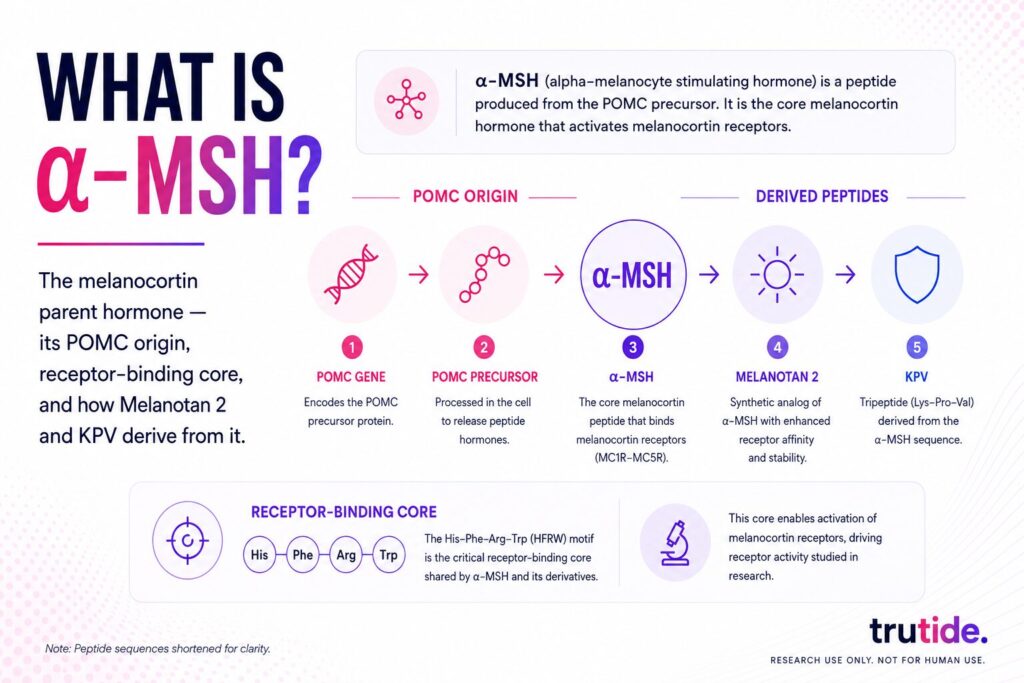
α-melanocyte-stimulating hormone (alpha-MSH) is a peptide hormone at the centre of the melanocortin system — the signalling network from which compounds such as Melanotan 2 and KPV are derived. It is a 13-amino-acid hormone produced from a larger precursor protein and acts across the melanocortin receptor family to influence pigmentation, inflammation, energy balance, and other functions. Understanding α-MSH is the key to understanding the melanocortin peptides, because each of them relates to α-MSH in a specific way — some mimic its receptor-binding action, others are fragments that carry only part of its activity. This guide explains what α-MSH is, where it comes from, how it acts on the melanocortin receptors, and how the research compounds derived from it relate to the parent hormone.
α-MSH at a glance
| Property | Detail |
|---|---|
| Full name | α-melanocyte-stimulating hormone |
| Type | Peptide hormone (13 amino acids) |
| Derived from | Proopiomelanocortin (POMC) precursor |
| Receptor targets | Melanocortin receptors (MC1R–MC5R) |
| Receptor-binding core | His-Phe-Arg-Trp sequence |
| Documented roles | Pigmentation, anti-inflammatory signalling, energy balance |
| Derived research compounds | Melanotan 2 (agonist), KPV (fragment) |
What α-MSH is
α-melanocyte-stimulating hormone is a small peptide hormone, thirteen amino acids in length, belonging to the melanocortin family of peptides. It is one of the principal naturally occurring melanocortins and acts as an endogenous signalling molecule across several physiological systems.
Its name reflects its first-discovered function — stimulating melanocytes, the pigment-producing cells of the skin — but α-MSH is now understood to have a far broader role than pigmentation alone. It acts on receptors distributed across many tissues, which is why a single hormone can influence processes as varied as skin pigmentation, inflammatory signalling, and central nervous system regulation of energy balance.
Where α-MSH comes from
α-MSH is not synthesised directly as a standalone gene product. Instead, it is cleaved from a large precursor protein called proopiomelanocortin (POMC). POMC is a remarkable precursor because it is processed into several different active peptides depending on the tissue and the enzymes present — including α-MSH, adrenocorticotropic hormone (ACTH), and others.
This shared origin is part of why the melanocortin peptides are a family: they trace back to a common precursor and share structural features. α-MSH itself corresponds to a specific segment of the POMC sequence, and its thirteen amino acids contain the regions responsible for binding and activating the melanocortin receptors.
How α-MSH acts on the melanocortin receptors
α-MSH exerts its effects by binding the melanocortin receptors — a family of five G protein-coupled receptors (MC1R through MC5R), each with a distinct tissue distribution and function. α-MSH binds several of them, which accounts for its wide-ranging activity.
The receptor-binding core
The part of α-MSH responsible for activating the receptors is a short central sequence — His-Phe-Arg-Trp (histidine-phenylalanine-arginine-tryptophan). This four-residue core is the receptor-binding pharmacophore: the minimal active region that the melanocortin receptors recognise. Its importance is central to understanding the derived compounds, because whether a compound retains or lacks this core determines whether it can act as a melanocortin receptor agonist at all.
The range of effects
Through its action on the different receptor subtypes, α-MSH influences pigmentation (via MC1R), central nervous system functions including energy balance and appetite (via MC3R and MC4R), and exocrine and peripheral functions (via MC5R). It also has well-documented anti-inflammatory activity, which is mediated through several mechanisms. This anti-inflammatory dimension is particularly relevant to one of its derived fragments, KPV.
The compounds derived from α-MSH
Several research compounds derive from or are based on α-MSH, and they relate to the parent hormone in different ways — a distinction that turns entirely on the receptor-binding core.
Melanotan 2 — retains the receptor-binding core
Melanotan 2 is a synthetic cyclic analogue of α-MSH that retains and stabilises the His-Phe-Arg-Trp receptor-binding core. As a result, it acts as a melanocortin receptor agonist — it binds and activates the receptors much as α-MSH does, though it is non-selective across MC1R, MC3R, MC4R, and MC5R. See our Melanotan 2 research guide.
KPV — lacks the receptor-binding core
KPV is the C-terminal tripeptide (lysine-proline-valine) of α-MSH. Crucially, it does not contain the central His-Phe-Arg-Trp receptor-binding core, so it cannot meaningfully activate the melanocortin receptors. Instead it carries forward part of α-MSH’s anti-inflammatory activity through a receptor-independent intracellular mechanism. See our KPV research guide.
The contrast between these two compounds — both derived from the same hormone, one retaining the receptor-binding core and one lacking it — is the clearest illustration of how α-MSH’s structure determines the behaviour of its derivatives. For the full family context, see our guide on melanocortin peptides.
Frequently asked questions
What is α-MSH?
α-melanocyte-stimulating hormone (α-MSH) is a 13-amino-acid peptide hormone derived from the POMC precursor protein. It acts on the melanocortin receptors (MC1R–MC5R) to influence pigmentation, anti-inflammatory signalling, energy balance, and other functions. It is the parent molecule of the melanocortin peptide family.
Where does α-MSH come from?
It is cleaved from a large precursor protein called proopiomelanocortin (POMC), which is processed into several active peptides including α-MSH and ACTH. α-MSH corresponds to a specific segment of the POMC sequence.
What is the receptor-binding core of α-MSH?
The central His-Phe-Arg-Trp (histidine-phenylalanine-arginine-tryptophan) sequence is the receptor-binding pharmacophore — the minimal active region the melanocortin receptors recognise. Whether a derived compound retains this core determines whether it can act as a melanocortin receptor agonist.
How do Melanotan 2 and KPV relate to α-MSH?
Both derive from α-MSH but differently. Melanotan 2 retains the His-Phe-Arg-Trp receptor-binding core and acts as a melanocortin receptor agonist. KPV is the C-terminal fragment, lacks the receptor-binding core, and acts through a receptor-independent anti-inflammatory mechanism instead.
Is α-MSH the same as melanin?
No. α-MSH is a hormone that, among its other functions, signals melanocytes via the MC1R receptor to influence melanin production. Melanin is the pigment itself. α-MSH is a signalling molecule; melanin is the pigment its signalling can influence.
Are α-MSH-derived compounds licensed as medicines?
Further reading
For the wider family context, see our guide on melanocortin peptides. For the derived compounds, see the Melanotan 2 research guide, the comparison Melanotan 1 vs Melanotan 2, and the KPV research guide.
Research use only. This article is provided for laboratory and scientific reference purposes. Trutide research products are supplied strictly for in vitro laboratory research and are not for human or veterinary use, clinical use, self-administration, diagnosis, treatment or prevention of disease.
References
- Cone RD. Studies on the physiological functions of the melanocortin system. Endocrine Reviews. 2006;27(7):736-749. doi:10.1210/er.2006-0034
- Catania A, Gatti S, Colombo G, Lipton JM. Targeting melanocortin receptors as a novel strategy to control inflammation. Pharmacological Reviews. 2004;56(1):1-29. doi:10.1124/pr.56.1.1
- Eberle AN. Proopiomelanocortin and the melanocortin peptides. In: The Melanocortin Receptors. Humana Press; 2000:3-67.
- Brzoska T, Luger TA, Maaser C, Abels C, Böhm M. α-Melanocyte-stimulating hormone and related tripeptides. Endocrine Reviews. 2008;29(5):581-602. doi:10.1210/er.2007-0027
- Wikberg JE, Muceniece R, Mandrika I, et al. New aspects on the melanocortins and their receptors. Pharmacological Research. 2000;42(5):393-420. doi:10.1006/phrs.2000.0725
Last updated: 15 June 2026