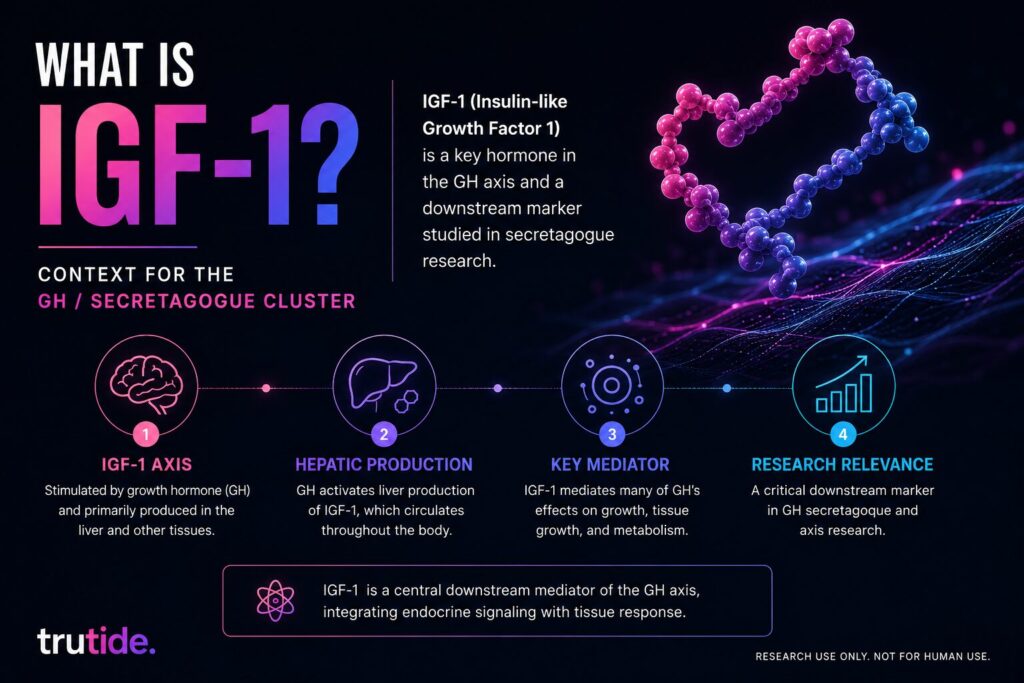
Insulin-like growth factor 1 (IGF-1) is a hormone that mediates many of the downstream effects of growth hormone, and it is one of the most frequently measured markers in growth hormone research. When researchers study growth hormone secretagogues — compounds that stimulate growth hormone release — IGF-1 is often the secondary endpoint they track, because it reflects the biological consequence of sustained growth hormone activity. Understanding IGF-1 and its relationship to growth hormone is therefore essential context for understanding why growth hormone secretagogue research is structured the way it is. This guide explains what IGF-1 is, the growth hormone–IGF-1 axis, where IGF-1 is produced, and why it matters as a research marker.
IGF-1 at a glance
| Property | Detail |
|---|---|
| Full name | Insulin-like growth factor 1 |
| Type | Peptide hormone, structurally related to insulin |
| Produced mainly in | The liver, in response to growth hormone |
| Triggered by | Growth hormone (GH) |
| Role | Mediates many downstream effects of growth hormone |
| Research relevance | Common secondary marker in GH secretagogue research |
| Half-life | Long relative to GH (hours), giving a stable readout |
What IGF-1 is
Insulin-like growth factor 1 is a peptide hormone that plays a central role in growth and tissue maintenance. Its name reflects its structural similarity to insulin — the two molecules share a related structure and some overlapping signalling — but IGF-1 has its own distinct functions, principally as the mediator of growth hormone’s effects throughout the body.
Much of what growth hormone “does” in tissues is actually carried out by IGF-1. Growth hormone acts in large part by triggering the production of IGF-1, which then goes on to produce many of the downstream effects associated with growth hormone activity. This makes IGF-1 a kind of second messenger for growth hormone at the whole-body level — and a particularly useful one to measure.
The growth hormone–IGF-1 axis
IGF-1 sits within a signalling cascade often called the GH–IGF-1 axis, which runs from the brain to the liver and out to the tissues:
- The hypothalamus releases growth hormone-releasing hormone (GHRH), and the stomach releases ghrelin — both signalling the pituitary.
- The pituitary releases growth hormone (GH) in response.
- Growth hormone travels to the liver and other tissues, where it stimulates the production of IGF-1.
- IGF-1 then mediates many of the downstream growth and tissue effects, and also feeds back to regulate the system.
This axis is the framework within which growth hormone secretagogues operate. A secretagogue acts at the top of the cascade — stimulating growth hormone release — and IGF-1 sits near the bottom, reflecting the consequence of that stimulation. Understanding the axis explains why measuring IGF-1 tells researchers something useful about a secretagogue’s effect.
Where IGF-1 is produced
The liver is the principal source of circulating IGF-1. When growth hormone reaches the liver, it stimulates hepatic production of IGF-1, which is then released into the bloodstream. While many tissues can produce IGF-1 locally, it is this growth-hormone-driven hepatic production that accounts for most of the IGF-1 measured in circulation — and therefore the IGF-1 that responds to changes in growth hormone activity.
This liver-centred, growth-hormone-driven production is what makes circulating IGF-1 such a useful readout: changes in it reflect changes in growth hormone activity reaching the liver.
Why IGF-1 matters as a research marker
In growth hormone secretagogue research, IGF-1 is frequently measured as a secondary endpoint alongside growth hormone itself. There is a practical reason for this, rooted in the very different pharmacokinetics of the two hormones.
Growth hormone is released in short pulses and has a brief half-life, so its blood levels fluctuate rapidly and are difficult to capture in a single measurement — a sample might land on a peak or a trough. IGF-1, by contrast, has a much longer half-life (hours rather than minutes) and circulates at more stable levels. This stability makes IGF-1 a more reliable integrated marker of sustained growth hormone activity over time: rather than catching a single fluctuating pulse, an IGF-1 measurement reflects the cumulative effect of growth hormone activity. This is why published research on growth hormone secretagogues so often reports IGF-1 as a key endpoint. For the compounds that drive this axis, see our guide on growth hormone secretagogues.
Frequently asked questions
What is IGF-1?
Insulin-like growth factor 1 (IGF-1) is a peptide hormone, structurally related to insulin, that mediates many of the downstream effects of growth hormone. It is produced mainly in the liver in response to growth hormone and is central to growth and tissue maintenance.
What is the relationship between growth hormone and IGF-1?
Growth hormone acts in large part by stimulating the liver to produce IGF-1, which then carries out many of growth hormone’s downstream effects. They form the GH–IGF-1 axis: growth hormone is released by the pituitary and triggers IGF-1 production, with IGF-1 mediating the effects and feeding back to regulate the system.
Where is IGF-1 produced?
Mainly in the liver, in response to growth hormone. While many tissues can produce IGF-1 locally, growth-hormone-driven hepatic production accounts for most of the IGF-1 measured in circulation.
Why is IGF-1 measured in growth hormone secretagogue research?
Because it is a more stable marker than growth hormone itself. Growth hormone is released in short pulses with a brief half-life, making it hard to capture reliably. IGF-1 has a longer half-life and steadier levels, so it serves as an integrated marker of sustained growth hormone activity over time.
Is IGF-1 the same as insulin?
No. IGF-1 is structurally related to insulin and shares some overlapping signalling, which is reflected in its name, but it is a distinct hormone with its own functions — principally as the mediator of growth hormone’s effects, rather than insulin’s role in glucose regulation.
Do growth hormone secretagogues affect IGF-1?
In published preclinical research, growth hormone secretagogues that elevate growth hormone have been reported to elevate circulating IGF-1 as a downstream consequence, since growth hormone drives hepatic IGF-1 production. This is why IGF-1 is commonly tracked as a secondary endpoint in such research.
Further reading
For the compounds that drive the growth hormone–IGF-1 axis, see our guide on growth hormone secretagogues and on ghrelin and the GHSR-1a receptor. For the leading research blend, see our CJC-1295 & Ipamorelin research guide.
Research use only. This article is provided for laboratory and scientific reference purposes. Trutide research products are supplied strictly for in vitro laboratory research and are not for human or veterinary use, clinical use, self-administration, diagnosis, treatment or prevention of disease.
References
- Le Roith D, Bondy C, Yakar S, Liu JL, Butler A. The somatomedin hypothesis: 2001. Endocrine Reviews. 2001;22(1):53-74. doi:10.1210/edrv.22.1.0419
- Ohlsson C, Mohan S, Sjögren K, et al. The role of liver-derived insulin-like growth factor-I. Endocrine Reviews. 2009;30(5):494-535. doi:10.1210/er.2009-0010
- Junnila RK, List EO, Berryman DE, Murrey JW, Kopchick JJ. The GH/IGF-1 axis in ageing and longevity. Nature Reviews Endocrinology. 2013;9(6):366-376. doi:10.1038/nrendo.2013.67
- Clemmons DR. Metabolic actions of insulin-like growth factor-I in normal physiology and diabetes. Endocrinology and Metabolism Clinics of North America. 2012;41(2):425-443. doi:10.1016/j.ecl.2012.04.017
- Teichman SL, Neale A, Lawrence B, et al. Prolonged stimulation of growth hormone and IGF-I secretion by CJC-1295. The Journal of Clinical Endocrinology & Metabolism. 2006;91(3):799-805. doi:10.1210/jc.2005-1536
Last updated: 18 June 2026