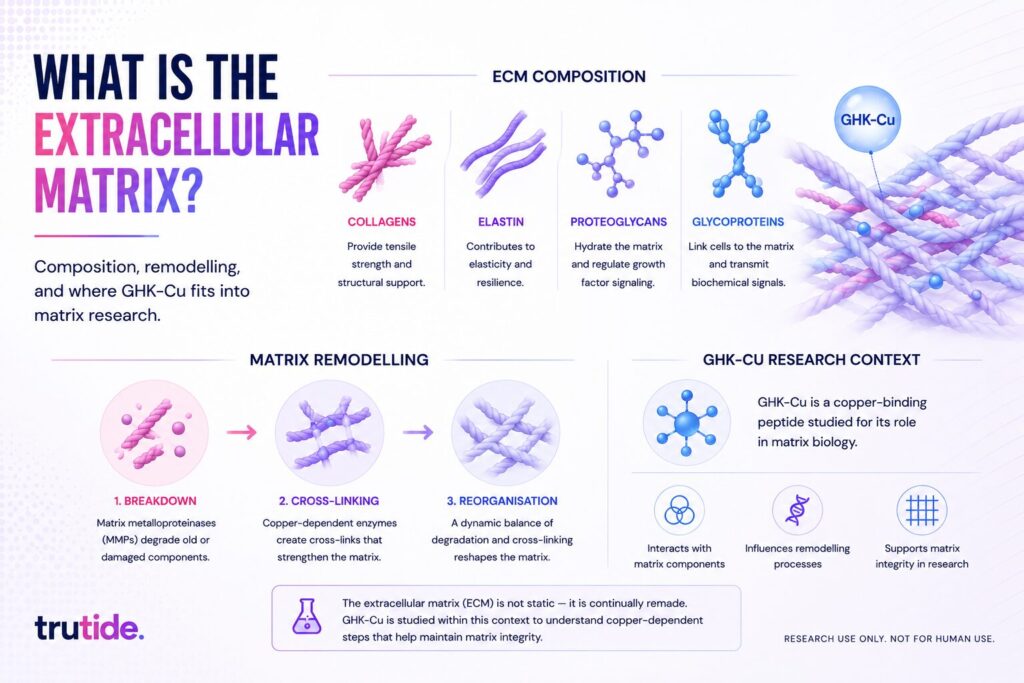
The extracellular matrix (ECM) is the structural network that surrounds and supports cells in tissue — the scaffolding that gives skin, connective tissue, and organs their form, strength, and elasticity. It is central to understanding a whole category of research peptides, because compounds such as GHK-Cu are studied specifically for their effects on extracellular matrix synthesis and remodelling. Understanding what the ECM is, what it is made of, and how it is continuously rebuilt provides the context for understanding how matrix-active peptides are thought to work. This guide explains the composition and function of the extracellular matrix, the process of matrix remodelling, and how research peptides intersect with this biology.
The extracellular matrix at a glance
| Component | Role |
|---|---|
| Collagen | Primary structural protein; tensile strength |
| Elastin | Elasticity and recoil |
| Glycosaminoglycans (GAGs) | Hydration, cushioning, volume |
| Proteoglycans | Structural organisation, signalling |
| Fibronectin / laminin | Cell adhesion and connection |
| Key remodelling enzyme | Lysyl oxidase (copper-dependent crosslinking) |
What the extracellular matrix is
The extracellular matrix is the network of molecules that exists outside of cells and provides structural and biochemical support to the surrounding tissue. Where cells are the living units of a tissue, the ECM is everything between them — the material that holds them in place, gives the tissue its physical properties, and provides a medium through which cells communicate and migrate.
It is not an inert filler. The extracellular matrix is a dynamic, actively maintained structure that is constantly being synthesised, broken down, and rebuilt. Its composition varies by tissue type — the ECM of skin differs from that of cartilage or bone — but the underlying principles and many of the key components are shared across tissues.
What the matrix is made of
Collagen
Collagen is the most abundant protein in the extracellular matrix and the primary source of its tensile strength. It forms fibres that give tissue its structural integrity and resistance to stretching. There are several types of collagen, with types I and III being particularly prominent in skin and connective tissue.
Elastin
Elastin provides elasticity — the ability of tissue to stretch and then recoil to its original shape. Where collagen provides strength, elastin provides flexibility, and the balance between the two determines a tissue’s mechanical properties.
Glycosaminoglycans and proteoglycans
Glycosaminoglycans (GAGs) are long carbohydrate chains that attract and hold water, giving the matrix hydration, volume, and cushioning. When attached to a protein core, they form proteoglycans, which contribute both to the matrix’s physical structure and to its role in organising signalling molecules. These components are responsible for much of the matrix’s resilience to compression.
Adhesion proteins
Proteins such as fibronectin and laminin connect cells to the surrounding matrix, anchoring them in place and providing the attachment points cells need to migrate, divide, and function. They are the link between the cellular and extracellular worlds.
Matrix remodelling
The extracellular matrix is continuously remodelled — a balance between synthesis of new matrix components and breakdown of old ones. This ongoing turnover is essential to tissue maintenance and becomes especially active in experimental models involving matrix disruption, remodelling and reorganisation.
A key step in matrix construction is the crosslinking of collagen and elastin fibres, which converts loose components into a strong, organised network. This crosslinking is performed by the enzyme lysyl oxidase — and lysyl oxidase is copper-dependent, requiring copper as a cofactor to function. This copper requirement is the point at which copper peptides intersect with matrix biology, and it is central to understanding how a compound like GHK-Cu is thought to act.
How research peptides intersect with the matrix
A category of research peptides is studied specifically for effects relevant to extracellular matrix synthesis and remodelling. The clearest example is GHK-Cu, the copper-binding tripeptide.
GHK-Cu is studied for two matrix-relevant mechanisms. First, it has documented effects on the expression of matrix genes — published research reports modulation of the genes encoding collagen, elastin, and the enzymes that synthesise glycosaminoglycans and proteoglycans, influencing the production of matrix components at the transcriptional level. Second, by providing bioavailable copper, it intersects with the copper-dependent crosslinking enzyme lysyl oxidase. Both mechanisms relate directly to the matrix processes described above. For full detail, see our GHK-Cu research guide and the explainer on copper peptides.
Matrix remodelling is studied across a range of cellular and tissue models. GHK-Cu appears in this literature because of its association with copper-dependent enzymes, fibroblast signalling and extracellular-matrix regulation.
Frequently asked questions
What is the extracellular matrix?
The extracellular matrix (ECM) is the network of molecules outside of cells that provides structural and biochemical support to tissue. It includes collagen, elastin, glycosaminoglycans, proteoglycans, and adhesion proteins, and it gives tissue its strength, elasticity, and form.
What is the matrix made of?
The main components are collagen (tensile strength), elastin (elasticity), glycosaminoglycans and proteoglycans (hydration and cushioning), and adhesion proteins such as fibronectin and laminin (connecting cells to the matrix).
What is matrix remodelling?
Matrix remodelling is the continuous process of synthesising new matrix components and breaking down old ones. It maintains tissue and becomes especially active during repair. A key step is the copper-dependent crosslinking of collagen and elastin by the enzyme lysyl oxidase.
How does GHK-Cu relate to the extracellular matrix?
GHK-Cu is studied for two matrix-relevant mechanisms: documented effects on the expression of matrix genes (collagen, elastin, and GAG-synthesising enzymes), and provision of bioavailable copper, which is a required cofactor for the matrix-crosslinking enzyme lysyl oxidase.
Why is copper important to the matrix?
Copper is a required cofactor for lysyl oxidase, the enzyme that crosslinks collagen and elastin fibres into a strong, organised network. Without adequate copper, this crosslinking step cannot proceed properly, which is why copper peptides are of interest in matrix research.
Can matrix-active peptides be used in humans?
No. Trutide research products are supplied strictly for in vitro laboratory and scientific research. They are not for human or veterinary use, clinical use, self-administration, diagnosis, treatment or prevention of disease.
Further reading
For the reference copper peptide and its matrix effects, see our GHK-Cu research guide and the explainer on copper peptides.
Research use only. This article is provided for laboratory and scientific reference purposes. Trutide research products are supplied strictly for in vitro laboratory research and are not for human or veterinary use, clinical use, self-administration, diagnosis, treatment or prevention of disease.
References
- Frantz C, Stewart KM, Weaver VM. The extracellular matrix at a glance. Journal of Cell Science. 2010;123(24):4195-4200. doi:10.1242/jcs.023820
- Pickart L, Margolina A. Regenerative and protective actions of the GHK-Cu peptide in the light of the new gene data. International Journal of Molecular Sciences. 2018;19(7):1987. doi:10.3390/ijms19071987
- Rucker RB, Kosonen T, Clegg MS, et al. Copper, lysyl oxidase, and extracellular matrix protein cross-linking. The American Journal of Clinical Nutrition. 1998;67(5 Suppl):996S-1002S. doi:10.1093/ajcn/67.5.996S
- Theocharis AD, Skandalis SS, Gialeli C, Karamanos NK. Extracellular matrix structure. Advanced Drug Delivery Reviews. 2016;97:4-27. doi:10.1016/j.addr.2015.11.001
- Kular JK, Basu S, Sharma RI. The extracellular matrix: structure, composition, age-related differences, tools for analysis and applications for tissue engineering. Journal of Tissue Engineering. 2014;5. doi:10.1177/2041731414557112
Last updated: 17 June 2026