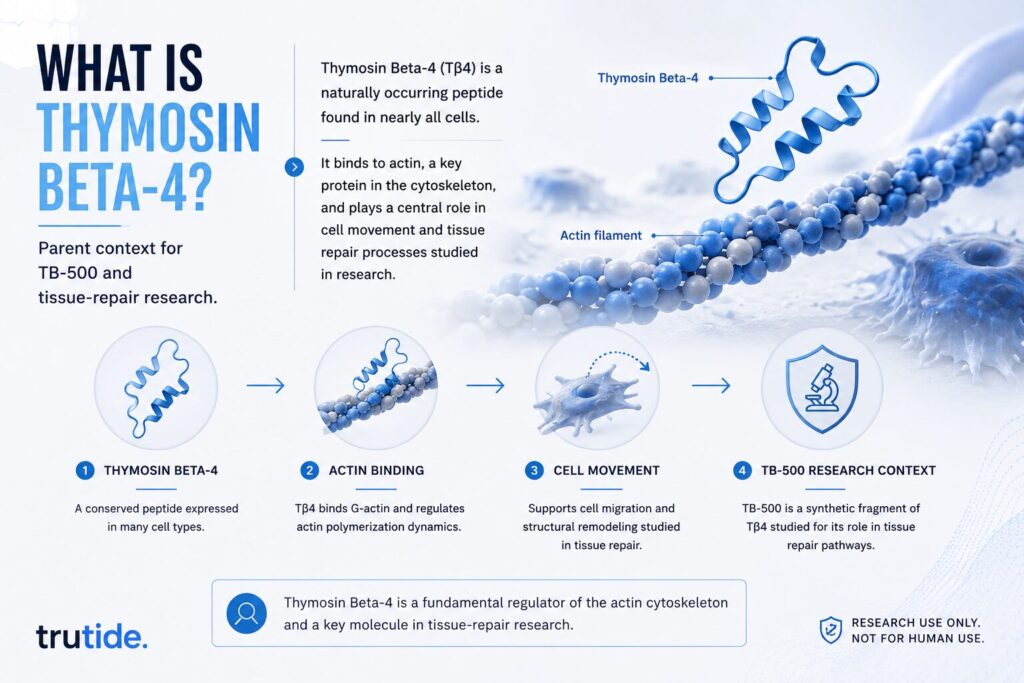
Thymosin beta-4 (TB-4) is one of the most abundant proteins inside mammalian cells and a molecule of wide-ranging biological importance, particularly in cytoskeletal regulation, actin dynamics and cellular migration. It is also the parent molecule of TB-500, the synthetic fragment widely used in peptide research. Understanding the full TB-4 protein provides the context for understanding TB-500, because TB-500 reproduces one specific region and one specific activity of the larger molecule. This guide explains what thymosin beta-4 is, its central role in actin regulation, the breadth of its documented research, and how the TB-500 fragment relates to the full protein.
Thymosin beta-4 at a glance
| Property | Detail |
|---|---|
| Type | Naturally occurring protein |
| Length | 43 amino acids |
| Abundance | One of the most abundant intracellular proteins in mammalian cells |
| Primary function | G-actin sequestration (cytoskeletal regulation) |
| Other documented roles | Angiogenesis, cell migration, inflammatory-signalling modulation, cytoskeletal regulation |
| Active fragment | TB-500 (residues 17–23, the actin-binding domain) |
What thymosin beta-4 is
Thymosin beta-4 is a small protein, 43 amino acids in length, found in virtually all mammalian cells. It is a member of the beta-thymosin family and is notable for its sheer abundance — it is one of the most plentiful proteins inside cells, present at high concentrations across many tissue types. This ubiquity reflects its fundamental role in basic cellular function.
Despite originally being associated with the thymus (hence the name), TB-4 is now understood to be a near-universal intracellular protein with functions extending far beyond immune tissue. Its prominence in cell biology comes principally from its role in regulating the actin cytoskeleton — the internal scaffolding that gives cells their shape and enables them to move.
The central role: actin sequestration
Thymosin beta-4’s primary and best-characterised function is actin sequestration. Actin is one of the most important structural proteins in cells, existing in two forms: monomeric G-actin (free building blocks) and polymeric F-actin (assembled filaments). The balance between these two forms governs cell shape, division, and movement.
TB-4 is the principal G-actin sequestering protein in cells. It binds free G-actin monomers in a one-to-one ratio, holding them in a reserve pool that is prevented from spontaneously polymerising but remains immediately available when the cell needs to build new filaments — for example, to change shape or migrate. By managing this reserve, TB-4 acts as a master regulator of the actin available for rapid cytoskeletal remodelling. This actin-binding activity is concentrated in a specific short region of the protein, which is the region reproduced by the TB-500 fragment.
The breadth of TB-4 research
Beyond actin binding, full-length thymosin beta-4 has been examined across several experimental domains.
- Cardiac experimental systems — studies measure cardiomyocyte, endothelial, progenitor-cell and vascular-remodelling endpoints.
- Corneal and epithelial systems — studies measure epithelial migration, inflammatory mediators and wound-model endpoints.
- Angiogenesis-associated research — studies examine endothelial migration, tube formation and vessel-associated measurements.
- Inflammatory-signalling research — studies examine cytokines and other inflammatory mediators in cellular and animal models.
The scope of these findings differs between full-length thymosin beta-4 and shorter fragments such as TB-500; results should not be treated as interchangeable.
How TB-500 relates to thymosin beta-4
TB-500 is a synthetic peptide corresponding to a specific region of thymosin beta-4 — residues 17 to 23, the actin-binding domain — with an acetylated N-terminus. It is a fragment of the full protein, not a synonym for it.
The relationship matters for research. TB-500 reproduces the actin-sequestration activity that is TB-4’s central function, which is why it is used as a focused research tool for studying actin dynamics and the cellular migration that depends on them. But the full TB-4 protein carries additional activities, residing in regions outside the 17–23 fragment, that TB-500 does not fully reproduce. Research requiring the complete spectrum of TB-4 effects uses the full-length protein; research focused on the actin-binding activity can use the more focused fragment. The two are mechanistically related but not interchangeable. For full detail on the fragment, see our TB-500 research guide.
Frequently asked questions
What is thymosin beta-4?
Thymosin beta-4 (TB-4) is a 43-amino-acid protein found in virtually all mammalian cells and one of the most abundant intracellular proteins. Its primary function is actin sequestration — regulating the cellular pool of actin available for cytoskeletal remodelling — and it has additional documented roles in angiogenesis, cell migration, and inflammatory-signalling modulation.
What does thymosin beta-4 do?
Its central function is binding and sequestering G-actin (monomeric actin), maintaining a reserve pool available for rapid cytoskeletal remodelling. This underlies its roles in cell shape, division, and migration. Published research also examines angiogenesis, cellular migration and inflammatory-signalling responses associated with the full-length protein.
Is thymosin beta-4 the same as TB-500?
No. Thymosin beta-4 is the full 43-amino-acid protein. TB-500 is a synthetic 8-amino-acid fragment corresponding to residues 17–23 (the actin-binding domain) of TB-4. TB-500 reproduces the actin-sequestration activity but not necessarily the full protein’s entire range of effects.
Why is thymosin beta-4 important in cells?
It is the principal G-actin sequestering protein, managing the reserve of actin monomers cells draw on to remodel their cytoskeleton. Since the actin cytoskeleton governs cell shape, division, and movement, TB-4’s regulatory role is fundamental to basic cell function, which is reflected in its high abundance.
Why use the TB-500 fragment instead of the full protein?
TB-500 is a smaller, more focused research tool that reproduces TB-4’s actin-binding activity. For research centred on actin dynamics and cellular migration, the fragment is sufficient. Research requiring the full spectrum of TB-4’s documented activities uses the full-length protein.
Can thymosin beta-4 or TB-500 be used in humans?
No. Trutide research products are supplied strictly for in vitro laboratory and scientific research. They are not for human or veterinary use, clinical use, self-administration, diagnosis, treatment or prevention of disease.
Further reading
For the synthetic fragment used in research, see our TB-500 research guide.
Research use only. This article is provided for laboratory and scientific reference purposes. Trutide research products are supplied strictly for in vitro laboratory research and are not for human or veterinary use, clinical use, self-administration, diagnosis, treatment or prevention of disease.
References
- Goldstein AL, Hannappel E, Sosne G, Kleinman HK. Thymosin β4: a multi-functional regenerative peptide. Basic properties and clinical applications. Expert Opinion on Biological Therapy. 2012;12(1):37-51. doi:10.1517/14712598.2012.634793
- Safer D, Elzinga M, Nachmias VT. Thymosin β4 and Fx, an actin-sequestering peptide, are indistinguishable. Journal of Biological Chemistry. 1991;266(7):4029-4032.
- Smart N, Risebro CA, Melville AA, et al. Thymosin β4 induces adult epicardial progenitor mobilization and neovascularization. Nature. 2007;445(7124):177-182. doi:10.1038/nature05383
- Crockford D, Turjman N, Allan C, Angel J. Thymosin beta4: structure, function, and biological properties. Annals of the New York Academy of Sciences. 2010;1194:179-189. doi:10.1111/j.1749-6632.2010.05492.x
- Sosne G, Qiu P, Goldstein AL, Wheater M. Biological activities of thymosin β4 defined by active sites in short peptide sequences. The FASEB Journal. 2010;24(7):2144-2151. doi:10.1096/fj.09-142307
Last updated: 19 June 2026