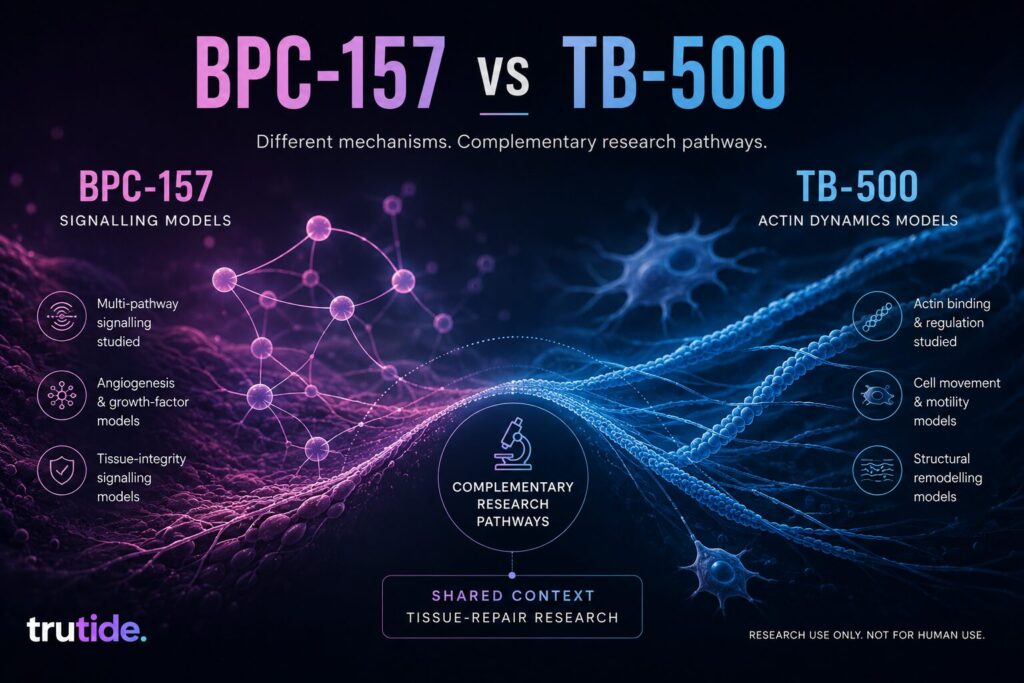
BPC-157 and TB-500 are structurally distinct research peptides with different molecular targets and experimental literature. This comparison focuses on their origins, biochemical mechanisms and the types of cellular pathways examined in published research, rather than on selecting either compound for personal or therapeutic use.
BPC-157 vs TB-500 at a glance
| Property | BPC-157 | TB-500 |
|---|---|---|
| Type | Synthetic pentadecapeptide (15 aa) | Synthetic fragment of Thymosin β-4 (8 aa) |
| Origin | Synthetic 15-aa peptide based on a gastric-protein sequence | Actin-binding region derived from thymosin beta-4 |
| Primary mechanism | Angiogenesis, cytoprotection, nitric oxide | Actin sequestration |
| Experimental pathway | Endothelial / nitric-oxide-associated signalling | Actin-associated cytoskeletal dynamics |
| Molecular weight | 1419.53 g/mol | 889.04 g/mol |
Different origins
BPC-157 is a synthetic 15-amino-acid peptide based on a sequence identified within a gastric protein. TB-500 is a synthetic peptide derived from the actin-binding region of thymosin beta-4.
Their different structures and origins are relevant because the published literature examines different molecular pathways for each compound.
Different mechanisms
BPC-157: endothelial and nitric-oxide-associated signalling
BPC-157 literature includes VEGF/VEGFR2-associated signalling, nitric-oxide pathways, FAK-paxillin signalling and cellular-stress or gastrointestinal experimental systems.
TB-500: actin-associated cytoskeletal dynamics
TB-500 literature centres on G-actin binding, cytoskeletal organisation, cellular migration and endothelial-response endpoints.
Distinct experimental targets
The mechanisms described in the literature are different, so comparative studies should define the endpoint being measured rather than treating one peptide as a substitute for the other.
Why compare the pathways in the same experimental system?
BPC-157 and TB-500 act through different molecular systems, which makes them useful for comparative or multi-factor experimental designs. BPC-157 literature includes endothelial and nitric-oxide-associated signalling, while TB-500 literature centres on actin-associated cytoskeletal organisation and cellular migration.
Research involving both compounds should measure the combined system directly rather than assuming additive effects from the individual literatures.
Further reading
For full mechanistic overviews, see the BPC-157 research guide and TB-500 research guide. For a formulation-level comparison of compounds that include these peptides, see the KLOW Blend component breakdown.
Research use only. This article is provided for laboratory and scientific reference purposes. Trutide research products are supplied strictly for in vitro laboratory research and are not for human or veterinary use, clinical use, self-administration, diagnosis, treatment or prevention of disease.
References
- Sikiric P, Seiwerth S, Rucman R, et al. Stable gastric pentadecapeptide BPC 157: novel therapy in gastrointestinal tract. Current Pharmaceutical Design. 2011;17(16):1612-1632. doi:10.2174/138161211796196954
- Chang CH, Tsai WC, Lin MS, Hsu YH, Pang JH. The promoting effect of pentadecapeptide BPC 157 on tendon healing involves tendon outgrowth, cell survival, and cell migration. Journal of Applied Physiology. 2011;110(3):774-780. doi:10.1152/japplphysiol.00945.2010
- Goldstein AL, Hannappel E, Sosne G, Kleinman HK. Thymosin β4: a multi-functional regenerative peptide. Expert Opinion on Biological Therapy. 2012;12(1):37-51. doi:10.1517/14712598.2012.634793
- Sosne G, Qiu P, Goldstein AL, Wheater M. Biological activities of thymosin β4 defined by active sites in short peptide sequences. The FASEB Journal. 2010;24(7):2144-2151. doi:10.1096/fj.09-142307
- Seiwerth S, Rucman R, Turkovic B, et al. BPC 157 and standard angiogenic growth factors. Current Pharmaceutical Design. 2018;24(18):1972-1989. doi:10.2174/1381612824666180712110447
Last updated: 20 June 2026