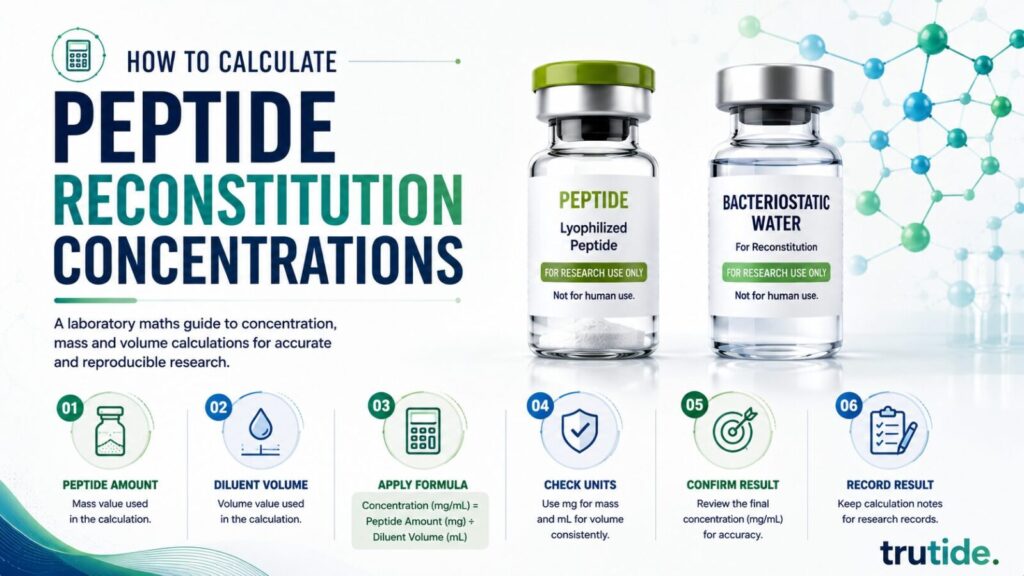
Peptide Reconstitution: calculating the concentration of a reconstituted research peptide is one of the most fundamental skills in peptide research, and it rests on a single simple relationship: the amount of peptide in the vial divided by the volume of bacteriostatic water added gives the concentration. Getting this calculation right is essential for accurate, reproducible work, because every subsequent measurement depends on knowing exactly how much peptide is present per unit volume. This guide explains the core formula, works through examples using real vial sizes, covers unit conversions, and highlights the common errors that lead to miscalculation. It deals only with concentration mathematics — how to know what is in your solution — not with dosing, which falls outside the scope of research-use information.
The core formula
The relationship at the heart of every reconstitution calculation is:
Concentration (mg/ml) = peptide mass in vial (mg) ÷ volume of solvent added (ml)
That is the whole basis. Everything else is applying this relationship and converting units. The peptide mass is stated on the vial and its Certificate of Analysis; the solvent volume is the amount of bacteriostatic water you choose to add. Once you know both, the concentration follows directly.
Worked examples
The table below shows the resulting concentration for several common vial sizes at different reconstitution volumes, using the core formula.
| Peptide mass in vial | Solvent added | Concentration |
|---|---|---|
| 10 mg | 1 ml | 10 mg/ml |
| 10 mg | 2 ml | 5 mg/ml |
| 30 mg | 2 ml | 15 mg/ml |
| 30 mg | 3 ml | 10 mg/ml |
| 100 mg | 5 ml | 20 mg/ml |
| 1000 mg | 10 ml | 100 mg/ml |
Each result is simply the mass divided by the volume. For example, a 30 mg vial reconstituted with 3 ml gives 30 ÷ 3 = 10 mg/ml. The same vial reconstituted with 2 ml gives 30 ÷ 2 = 15 mg/ml. The more solvent you add, the lower the concentration; the less solvent, the higher.
Converting to micrograms
Research measurements are often expressed in micrograms (mcg or µg) rather than milligrams, so unit conversion is frequently needed. The conversion is straightforward:
- 1 mg = 1000 mcg
- So a concentration of 5 mg/ml is equal to 5000 mcg/ml.
- A concentration of 10 mg/ml is equal to 10,000 mcg/ml.
To find how much peptide is in a given volume of your solution, multiply the concentration by the volume. For example, at 5 mg/ml (5000 mcg/ml), a 0.1 ml volume contains 0.5 mg, or 500 mcg. This is the second core relationship: amount = concentration × volume.
Choosing a reconstitution volume
Because the concentration depends on the solvent volume you choose, the volume is a decision rather than a fixed value. A few practical considerations inform it.
A larger solvent volume produces a lower concentration, which can make small measured quantities easier to handle with reasonable precision — very small volumes are harder to measure accurately. A smaller solvent volume produces a more concentrated solution, which conserves space and may suit work requiring larger amounts per measured volume. The vial’s physical capacity also sets a practical upper limit on how much solvent can be added. Many researchers choose a volume that yields a round-number concentration (such as adding 2 ml to a 10 mg vial for exactly 5 mg/ml) to simplify subsequent calculations.
For the mechanics of carrying out the reconstitution itself, see our guide on how to reconstitute research peptides, and for detail on the solvent, our bacteriostatic water guide.
Common errors to avoid
- Confusing mg and mcg. A factor-of-1000 error is the most common and most serious mistake. Always confirm which unit a figure is in before calculating.
- Assuming the vial volume equals the solvent volume. The concentration depends on the volume of bacteriostatic water you add, not the size of the vial. A 10 mg peptide in a 3 ml vial reconstituted with 2 ml is at 5 mg/ml, not 10 ÷ 3.
- Forgetting net peptide content. The mass used in the calculation is the peptide mass. For most purposes the labelled mass is used, but be aware that net peptide content (from the COA) can differ slightly from total dry mass — see our guide to reading a Janoshik COA.
- Measurement imprecision at very small volumes. If your calculation requires measuring an extremely small volume, consider reconstituting at a lower concentration (more solvent) so the measured volumes are large enough to handle accurately.
Frequently asked questions
How do I calculate peptide concentration after reconstitution?
Divide the peptide mass in the vial (in mg) by the volume of bacteriostatic water added (in ml). The result is the concentration in mg/ml. For example, 10 mg reconstituted with 2 ml gives 5 mg/ml.
How do I convert mg/ml to mcg/ml?
Multiply by 1000, since 1 mg = 1000 mcg. So 5 mg/ml equals 5000 mcg/ml, and 10 mg/ml equals 10,000 mcg/ml.
How much peptide is in a given volume of solution?
Multiply the concentration by the volume. At 5 mg/ml, a 0.1 ml volume contains 0.5 mg (500 mcg). The relationship is: amount = concentration × volume.
Does the vial size determine the concentration?
No. The concentration depends on the volume of bacteriostatic water you add, not the physical size of the vial. The vial size only sets a practical upper limit on how much solvent will fit.
What volume should I reconstitute with?
It is a choice. More solvent gives a lower concentration (easier to measure small amounts precisely); less solvent gives a higher concentration. Many researchers pick a volume that produces a round-number concentration to simplify later calculations. The vial’s capacity sets the upper limit.
What is the most common calculation error?
Confusing milligrams and micrograms — a factor-of-1000 error. Always confirm the unit before calculating. The second most common is assuming the vial volume equals the solvent volume; the concentration depends only on the solvent you actually add.
Further reading
For the practical mechanics of reconstitution, see our guide on how to reconstitute research peptides. For detail on the solvent, see our bacteriostatic water guide, and for storage of the resulting solution, how to store research peptides correctly.
Trutide supplies bacteriostatic water in 3 ml and 10 ml vials for reconstitution, alongside its research-grade peptide catalogue, all independently tested by Janoshik Analytical.
Research use only. This article is intended for qualified researchers only. All information is provided for educational and scientific reference purposes. Nothing in this article constitutes medical advice. Products supplied by Trutide are strictly for in vitro laboratory research and are not for human or veterinary use.
Last updated: 13 June 2026