Age Verification

This website sells research chemicals for in vitro laboratory use only. You must be 18 or over to enter. By entering you confirm you are a qualified researcher and agree to our Terms & Conditions.

Sorry, you must be 18 or over to access this site.

For research use only. Not for human consumption.

📦 £5.99 Royal Mail Tracked 24 on every order — same-day dispatch on orders before 2pm

Research use only. All products are sold strictly for in vitro laboratory and scientific research. Not for human or veterinary use.

Home Research Library KLOW Blend: A Research Overview

KLOW Blend: A Research Overview

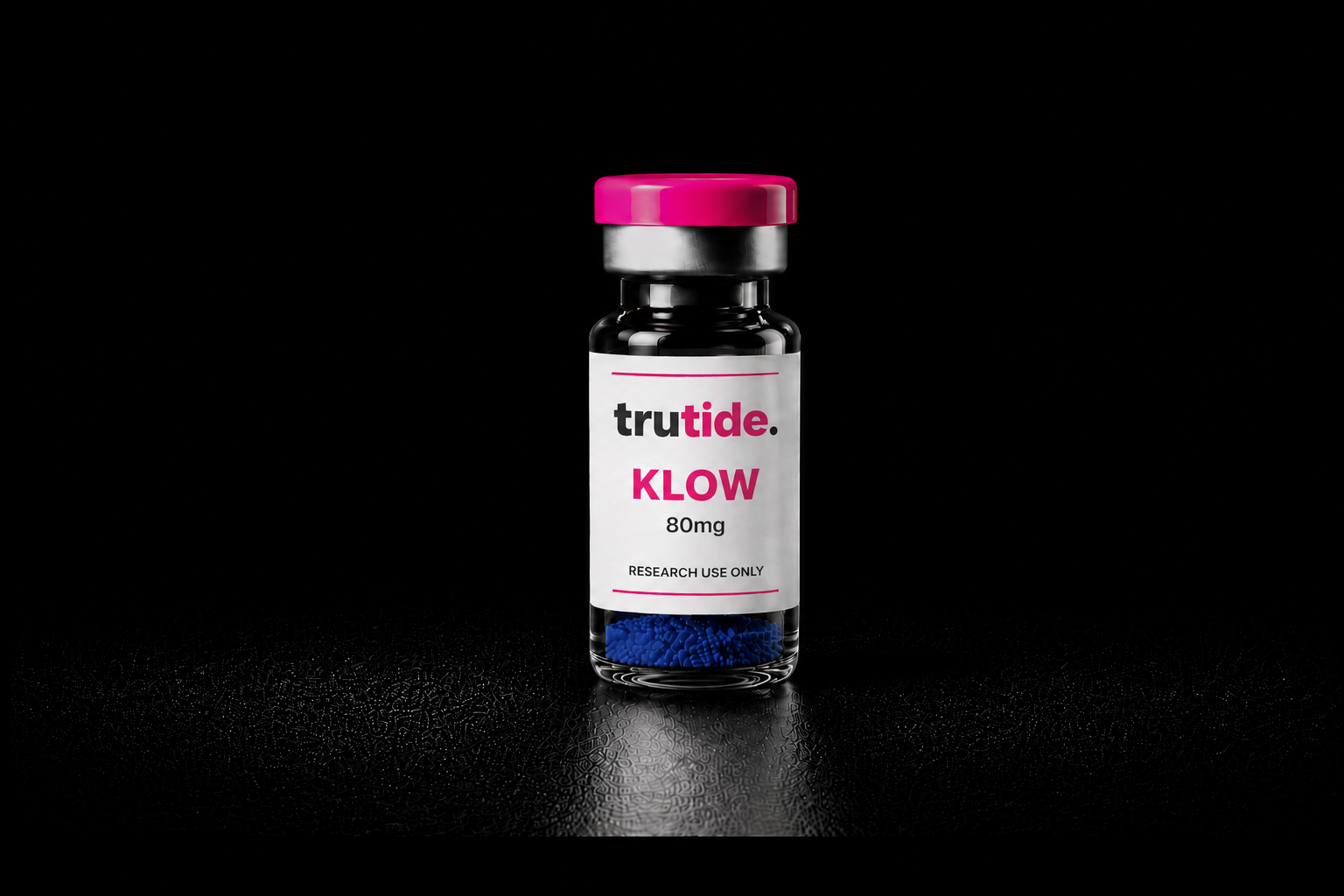
KLOW 80mg peptide blend lyophilised powder

KLOW is a four-peptide research blend that brings together some of the most widely studied compounds in regenerative and anti-inflammatory preclinical science. Combining GHK-Cu, BPC-157, TB-500, and KPV into a single 80mg lyophilised formulation, it is designed for laboratory investigations exploring how complementary mechanisms — collagen synthesis, angiogenesis, cytoprotection, cell migration, and immune modulation — interact within coordinated tissue repair models. This guide is a working reference for laboratory researchers: blend composition, the rationale behind multi-peptide formulation, individual and synergistic mechanisms, published research for each component, handling protocols, and quality considerations.

Quick reference

PropertyValue
Blend typeFour-peptide regenerative/anti-inflammatory research blend
Total content80 mg per vial
GHK-Cu50 mg (copper tripeptide)
BPC-15710 mg (gastric pentadecapeptide)
TB-50010 mg (thymosin beta-4 fragment)
KPV10 mg (α-MSH C-terminal tripeptide)
FormBlue-tinged lyophilised cake
Purity≥98% per peptide (HPLC verified)
SolubilitySoluble in bacteriostatic water after reconstitution
Storage−20°C, protected from light and moisture

Trutide supplies KLOW as a research-grade 80mg lyophilised blend, with each component independently tested at ≥98% HPLC purity by Janoshik Analytical. View product details →


Why a multi-peptide blend?

Tissue repair and regeneration involve multiple overlapping biological processes — inflammation control, blood vessel formation, cell migration to injury sites, extracellular matrix remodelling, and collagen synthesis. No single peptide addresses all of these simultaneously. The rationale behind multi-peptide blends like KLOW is to engage several of these pathways in parallel, creating a more comprehensive research model than any single compound allows.

From a practical laboratory standpoint, pre-blended formulations also reduce the logistical complexity of multi-compound experiments. Rather than reconstituting four separate vials and calculating independent concentrations, researchers work with a single standardised formulation with known ratios. This improves reproducibility across experiments and reduces handling-related variability.

The KLOW blend specifically pairs compounds that target different but complementary stages of the repair process: GHK-Cu for matrix remodelling and collagen synthesis, BPC-157 for angiogenesis and cytoprotection, TB-500 for cell migration and cytoskeletal reorganisation, and KPV for anti-inflammatory signalling. Published preclinical research exists for each component individually; the blend enables investigation of how these mechanisms interact when engaged simultaneously.


Component mechanisms

Each peptide in the KLOW blend has a distinct pharmacological profile. Understanding these individually is essential to interpreting results from the combined formulation.

GHK-Cu (50mg) — Copper tripeptide

GHK-Cu (glycyl-L-histidyl-L-lysine copper complex) is a naturally occurring tripeptide-copper complex found in human plasma, saliva, and urine. Plasma concentrations decline significantly with age — from approximately 200 ng/mL at age 20 to approximately 80 ng/mL by age 60 — which has driven research interest in its role in age-related tissue changes.

Published research has identified GHK-Cu as a modulator of gene expression, with studies reporting upregulation of genes associated with collagen synthesis, elastin production, glycosaminoglycan synthesis, and extracellular matrix remodelling. The copper ion is integral to GHK-Cu’s activity, serving as a cofactor for enzymes involved in collagen crosslinking (lysyl oxidase) and antioxidant defence (superoxide dismutase).

In preclinical wound healing models, GHK-Cu has been reported to accelerate wound closure, increase angiogenesis, and improve tensile strength of healed tissue. Research published by Pickart and colleagues has characterised GHK-Cu’s effects on fibroblast proliferation, decorin synthesis, and metalloproteinase regulation (Pickart et al., 2015).

GHK-Cu comprises the largest component of the KLOW blend (50mg of 80mg total), reflecting its role as the primary matrix-remodelling signal in the formulation. The blue tinge of the lyophilised cake is characteristic of the copper complex.

BPC-157 (10mg) — Gastric pentadecapeptide

BPC-157 (Body Protection Compound-157) is a synthetic 15-amino-acid peptide derived from a protective protein found in human gastric juice. Its published preclinical research base spans tendon and ligament repair, wound healing, gastrointestinal cytoprotection, and vascular function.

The compound’s proposed mechanisms include modulation of the nitric oxide system, promotion of angiogenesis via VEGF and VEGFR2 upregulation, interaction with growth factor signalling pathways (FGF, EGF, TGF-β), and activation of the FAK-paxillin pathway involved in cell migration and adhesion. Published research has reported cytoprotective effects in gastric ulcer, intestinal damage, and inflammatory bowel models in animals (Sikiric et al., 2018).

Within the KLOW blend, BPC-157 contributes the angiogenesis and cytoprotection arm — promoting blood vessel formation at repair sites and protecting tissues from further damage during the healing process.

For a comprehensive overview of BPC-157’s research base, see our dedicated BPC-157 research guide.

TB-500 (10mg) — Thymosin beta-4 fragment

TB-500 is a synthetic peptide fragment of thymosin beta-4, a 43-amino-acid protein that plays a central role in actin polymerisation and cytoskeletal organisation. Thymosin beta-4 is one of the most abundant actin-binding proteins in mammalian cells and is involved in cell migration, differentiation, and survival.

Published research has reported that TB-500 promotes cell migration by sequestering actin monomers and enabling cytoskeletal reorganisation — effectively mobilising repair cells to injury sites. Studies have also demonstrated effects on angiogenesis, with TB-500 promoting new blood vessel formation in ischaemic tissue models. Research by Goldstein and colleagues has characterised the role of thymosin beta-4 in wound healing, cardiac repair, and anti-inflammatory pathways (Goldstein et al., 2007).

Within the KLOW blend, TB-500 contributes the cell migration and tissue remodelling arm — facilitating movement of fibroblasts, endothelial cells, and other repair cells to sites requiring attention.

KPV (10mg) — α-MSH tripeptide fragment

KPV (Lys-Pro-Val) is a C-terminal tripeptide fragment of alpha-melanocyte-stimulating hormone (α-MSH). Unlike full-length α-MSH, KPV retains the anti-inflammatory signalling properties without the melanotropic (skin-darkening) effects, making it a cleaner research tool for investigating inflammation pathways.

Published research has identified KPV’s primary mechanism as inhibition of NF-κB signalling — a master regulator of inflammatory gene expression. By suppressing NF-κB nuclear translocation, KPV reduces production of pro-inflammatory cytokines including TNF-α, IL-1β, and IL-6 in preclinical models. Research by Getting et al. (1999) characterised KPV’s anti-inflammatory effects and demonstrated efficacy in models of colitis, dermatitis, and systemic inflammation.

More recent research has investigated KPV in gastrointestinal inflammation models, with studies exploring oral delivery systems using nanoparticle carriers to target intestinal inflammation directly (Xiao et al., 2017).

Within the KLOW blend, KPV is the dedicated anti-inflammatory component — controlling the inflammatory environment that can otherwise impede the repair processes driven by the other three peptides. This is what distinguishes KLOW from simpler two-peptide repair blends.


Synergistic interactions

The rationale behind the KLOW formulation is that tissue repair involves sequential and overlapping biological processes that benefit from concurrent multi-pathway engagement. Published research on the individual components suggests several potentially synergistic pairings within the blend.

BPC-157 + TB-500: Angiogenesis and cell migration

Both peptides promote angiogenesis through different mechanisms — BPC-157 via VEGF/VEGFR2 upregulation and nitric oxide modulation, TB-500 via actin-mediated endothelial cell migration. Combined engagement of both pathways may produce a more complete angiogenic response than either compound alone, with BPC-157 stimulating vessel formation and TB-500 facilitating the cellular migration required to build those vessels.

GHK-Cu + BPC-157: Matrix remodelling and vascularisation

GHK-Cu drives collagen synthesis and extracellular matrix organisation, while BPC-157 promotes the blood supply needed to sustain newly formed tissue. This pairing addresses both the structural scaffold (collagen, elastin, glycosaminoglycans) and the vascular infrastructure required to maintain it.

KPV + BPC-157: Inflammation control and cytoprotection

Chronic inflammation impairs tissue repair by sustaining damage faster than repair mechanisms can act. KPV’s NF-κB inhibition reduces the inflammatory load, while BPC-157’s cytoprotective effects shield tissues from ongoing damage. This combination is of particular research interest in gastrointestinal inflammation models where both peptides have independently demonstrated activity.

TB-500 + GHK-Cu: Cell mobilisation and matrix synthesis

TB-500 facilitates migration of repair cells (fibroblasts, endothelial cells) to injury sites, while GHK-Cu activates gene expression programmes for matrix synthesis once those cells arrive. This represents a logical sequence: mobilise repair resources, then provide the signals to build new tissue.

It is important to note that while individual peptide mechanisms are well-documented in published literature, research specifically examining the four-way combination in controlled studies remains limited. The synergistic rationale is based on complementary mechanism analysis rather than published head-to-head comparison data for the full blend.


Research applications

The KLOW blend’s multi-pathway profile makes it relevant across several preclinical research domains. Published research on the individual components supports investigation in the following areas.

Wound healing and tissue repair

All four components have published research demonstrating effects in wound healing models. GHK-Cu accelerates wound closure and improves tissue quality. BPC-157 promotes angiogenesis at wound sites. TB-500 mobilises repair cells. KPV reduces the inflammatory environment that slows healing. The blend enables investigation of how these processes interact during coordinated wound repair.

Musculoskeletal research

BPC-157 has published research in tendon and ligament repair models. TB-500 has been studied for muscle repair and recovery. GHK-Cu contributes collagen and connective tissue support. This combination is relevant for research examining joint, tendon, and soft tissue repair pathways.

Gastrointestinal research

Both BPC-157 and KPV have independently demonstrated activity in gastrointestinal inflammation models. BPC-157’s gastric origin makes it a natural fit for GI research, while KPV’s NF-κB inhibition addresses the inflammatory signalling that drives conditions like colitis. The combination enables investigation of coordinated cytoprotection and inflammation control in GI models.

Skin and dermatological research

GHK-Cu is the most extensively studied peptide for skin-related research, with published data on collagen stimulation, elastin production, and skin remodelling. KPV has published research in dermatitis models. The blend supports investigation of skin repair, ageing-related tissue changes, and inflammatory skin conditions.


Handling and storage

Proper handling is critical to preserving the integrity of all four components and ensuring reproducibility in research applications.

Lyophilised storage

Trutide supplies KLOW as a blue-tinged lyophilised cake in sealed vials. The blue colouration is characteristic of the copper complex in GHK-Cu and is expected. Unopened vials should be stored at −20°C in a dry, dark environment protected from light and moisture. When stored correctly, the lyophilised blend is stable for up to 24-36 months.

Allow vials to equilibrate to room temperature before opening to prevent moisture condensation on the powder.

Reconstitution

KLOW is reconstituted using sterile bacteriostatic water (BAC water) containing 0.9% benzyl alcohol as a preservative.

Standard reconstitution protocol:

  1. Allow the KLOW vial and BAC water to reach room temperature.
  2. Add 2-5 mL of BAC water slowly along the side of the vial.
  3. Gently swirl or tilt the vial until the powder is fully dissolved. Do not shake vigorously, as this can cause foaming or peptide degradation.
  4. Once reconstituted, the solution should be clear with a slight blue tint (from the GHK-Cu copper complex).

For more detail on reconstitution best practice, see our guide on how to reconstitute research peptides.

Reconstituted storage

Once reconstituted, KLOW solutions should be stored at 2-8°C (refrigerated) and used within 28 days. Do not refreeze reconstituted solutions, as freeze-thaw cycles can compromise peptide integrity — particularly for the larger peptides (BPC-157 and TB-500) in the blend.

Handling notes

  • Always work in a sterile environment using aseptic technique
  • Avoid repeated freeze-thaw cycles with the lyophilised powder
  • Protect from direct light and excessive heat during experimental procedures
  • Discard any unused solution that becomes cloudy or contains visible particulates
  • Follow your laboratory’s standard operating procedures for handling research peptides

For comprehensive guidance on peptide storage protocols, see how to store research peptides correctly.


Quality considerations

Multi-peptide blends present specific quality challenges that don’t apply to single-compound products. Researchers should understand these when selecting a supplier.

Per-component purity

Trutide’s KLOW is formulated from individually tested peptides, each verified at ≥98% HPLC purity before blending. This is a critical distinction — some suppliers blend first and test afterward, which can mask impurities in individual components behind an aggregate purity figure. Per-component testing ensures each peptide meets research-grade standards independently.

Ratio accuracy

The KLOW blend contains a specific ratio: 50mg GHK-Cu, 10mg BPC-157, 10mg TB-500, 10mg KPV. Accurate weighing and blending is essential for reproducible research. Trutide’s batch-specific Certificate of Analysis documents the composition of each blend lot.

Certificate of Analysis

Every batch of Trutide KLOW is supplied with a batch-specific COA documenting per-component HPLC purity, mass spectrometry confirmation, batch number, and independent third-party verification.

To learn more about what a COA contains and why it matters, see our guide on what is a Certificate of Analysis.

For a fuller explanation of HPLC purity testing, see our guide on understanding peptide purity.


Frequently asked questions

What is KLOW?

KLOW is a four-peptide research blend combining GHK-Cu (50mg), BPC-157 (10mg), TB-500 (10mg), and KPV (10mg) in a single 80mg lyophilised vial. It is designed for laboratory research into tissue repair, regeneration, anti-inflammatory pathways, and wound healing models.

What peptides are in KLOW?

KLOW contains four peptides: GHK-Cu (a copper tripeptide studied for collagen synthesis and matrix remodelling), BPC-157 (a gastric pentadecapeptide studied for angiogenesis and cytoprotection), TB-500 (a thymosin beta-4 fragment studied for cell migration and tissue repair), and KPV (an α-MSH tripeptide fragment studied for anti-inflammatory signalling via NF-κB inhibition).

Why is the KLOW powder blue?

The blue tinge of the lyophilised cake is characteristic of the copper complex in GHK-Cu, which makes up 50mg of the 80mg total. Copper(II) complexes characteristically produce blue colouration. This is expected and indicates the presence of the copper tripeptide component.

How is KLOW different from using each peptide separately?

KLOW provides a pre-formulated blend at standardised ratios, reducing the logistical complexity of reconstituting and dosing four separate vials. From a research perspective, the blend enables investigation of multi-pathway interactions in a single experimental protocol. However, researchers who need to vary the ratio of individual components should use separate vials instead.

How should KLOW be reconstituted?

KLOW is reconstituted using sterile bacteriostatic water (BAC water). Add 2-5 mL slowly along the side of the vial. Swirl gently to dissolve — do not shake vigorously. The reconstituted solution should be clear with a slight blue tint.

How should KLOW be stored?

Lyophilised KLOW should be stored at −20°C, protected from light and moisture. Reconstituted solutions should be stored at 2-8°C and used within 28 days. Do not refreeze reconstituted material.

What purity grade is KLOW tested to?

Each peptide component in Trutide’s KLOW is independently tested at ≥98% HPLC purity before blending. Every batch is supplied with a Certificate of Analysis from Janoshik Analytical documenting per-component purity and mass spectrometry confirmation.

Can KLOW be used in humans?

No. KLOW supplied by Trutide is intended strictly for in vitro laboratory and scientific research. It is not for human or veterinary consumption, clinical use, or self-administration.

Is KLOW legal to purchase in the UK?

KLOW supplied as a research chemical for in vitro laboratory use only is purchased lawfully by qualified researchers in the UK. By purchasing from Trutide, the buyer warrants they are a legitimate researcher and accepts responsibility for compliance with applicable laws in their jurisdiction.


Trutide’s KLOW 80mg blend

Trutide supplies research-grade KLOW to UK-based laboratory researchers:

  • 80mg per vial lyophilised blend (GHK-Cu 50mg + BPC-157 10mg + TB-500 10mg + KPV 10mg)
  • ≥98% HPLC purity per component independently verified
  • Janoshik Analytical third-party testing on every batch
  • Batch-specific COA available on request
  • Royal Mail Tracked 24 UK dispatch with same-day fulfilment on orders before 2pm
  • In stock with consistent supply

View KLOW 80mg product page →

You may also need bacteriostatic water for reconstitution.

Research use only. This article is intended for qualified researchers only. All information is provided for educational and scientific reference purposes. Nothing in this article constitutes medical advice. KLOW supplied by Trutide is strictly for in vitro laboratory research and is not for human or veterinary use.


References

  1. Pickart L, Vasquez-Soltero JM, Margolina A. GHK Peptide as a Natural Modulator of Multiple Cellular Pathways in Skin Regeneration. BioMed Research International. 2015;2015:648108. doi:10.1155/2015/648108
  2. Pickart L, Vasquez-Soltero JM, Margolina A. GHK-Cu may prevent oxidative stress in skin by regulating copper and modifying expression of numerous antioxidant genes. Cosmetics. 2015;2(3):236-247.
  3. Sikiric P, Seiwerth S, Rucman R, et al. Pentadecapeptide BPC 157 and its effects: a review. Journal of Physiology and Pharmacology. 2018;69(3).
  4. Chang CH, Tsai WC, Lin MS, et al. The promoting effect of pentadecapeptide BPC 157 on tendon healing involves tendon outgrowth, cell survival, and cell migration. Journal of Applied Physiology. 2011;110(3):774-780. doi:10.1152/japplphysiol.00945.2010
  5. Goldstein AL, Hannappel E, Sosne G, Kleinman HK. Thymosin β4: a multi-functional regenerative peptide. Basic properties and clinical applications. Expert Opinion on Biological Therapy. 2012;12(1):37-51.
  6. Philp D, Huff T, Gho YS, Hannappel E, Kleinman HK. The actin binding site on thymosin beta4 promotes angiogenesis. FASEB Journal. 2003;17(14):2103-2105.
  7. Getting SJ, Christian HC, Flower RJ, Perretti M. Activation of melanocortin type 3 receptor as a molecular mechanism for adrenocorticotropic hormone efficacy in gouty arthritis. Arthritis and Rheumatism. 2002;46(10):2765-2775.
  8. Xiao B, Xu Z, Viennois E, et al. Orally Targeted Delivery of Tripeptide KPV via Hyaluronic Acid-Functionalized Nanoparticles Efficiently Alleviates Ulcerative Colitis. Molecular Therapy. 2017;25(7):1628-1640. doi:10.1016/j.ymthe.2016.11.020

Last updated: 16 May 2026

Research use only. This article is intended for qualified researchers only. All information is provided for educational and scientific reference purposes. Nothing in this article constitutes medical advice.
← Back to Research Library