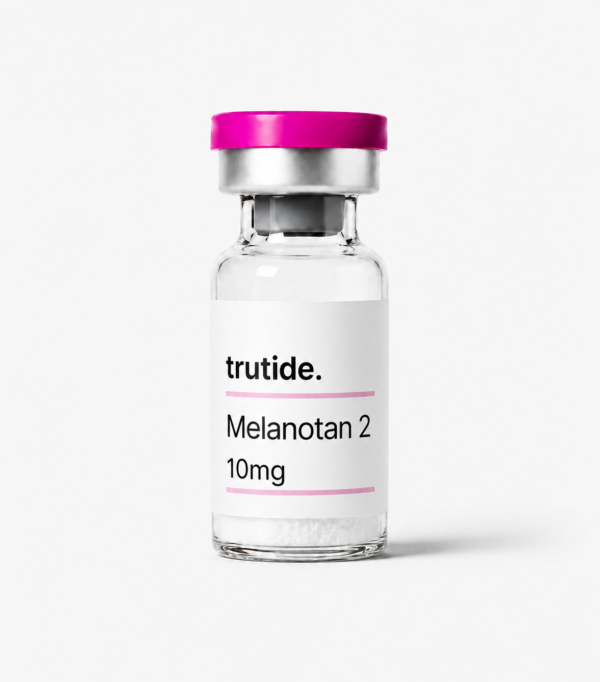
Melanotan 2 10mg
Melanotan 2 (MT-II) is a synthetic cyclic heptapeptide analog of α-melanocyte-stimulating hormone (α-MSH). It is widely studied in laboratory research for its strong affinity to melanocortin receptors (MC1R, MC3R, MC4R, MC5R) and its effects on melanogenesis, pigmentation pathways, and other melanocortin-mediated processes.
Supplied as a high-purity lyophilized powder for in vitro and scientific research. Melanotan 2 is commonly investigated in models exploring skin pigmentation, tanning mechanisms, appetite regulation, and melanocortin receptor pharmacology.
Key Features
- High purity ≥98% (HPLC verified)
- 10mg per vial
- Cyclic structure for enhanced stability
- Batch-specific Certificate of Analysis included
| Compound | Melanotan 2 (MT-II) |
| Form | Lyophilized white powder |
| Amount per vial | 10 mg |
| Purity | ≥98% (HPLC verified) |
| Amino Acid Length | 7 amino acids (cyclic heptapeptide) |
| Sequence | Ac-Nle-cyclo[Asp-His-D-Phe-Arg-Trp-Lys]-NH₂ |
| Molecular Formula | C₅₀H₆₉N₁₅O₉ |
| Molecular Weight | 1024.18 g/mol |
| CAS Number | 121062-08-6 |
| Solubility | Soluble in bacteriostatic water after reconstitution |
| Storage (lyophilized) | –20°C, protected from light and moisture |
Batch-specific Certificates of Analysis (COA) and HPLC purity reports are available on request.
Lyophilized Storage
Store unopened vials at –20°C in a dry, dark environment, protected from light and moisture. When stored correctly, the lyophilized powder is stable for up to 24–36 months.
Reconstitution Instructions
- Use sterile bacteriostatic water (BAC water) for reconstitution.
- Recommended volume: Add 1–2 mL of BAC water slowly along the side of the vial to achieve desired concentration (e.g., 5–10 mg/mL).
- Gently swirl or tilt the vial until the powder is fully dissolved. Do not shake vigorously to avoid foaming or degradation.
- Once reconstituted, store the solution in a refrigerator at 2–8°C and use within 28 days.
Handling Notes
- Always maintain sterile/aseptic technique during reconstitution and handling.
- Avoid repeated freeze-thaw cycles.
- Protect from direct light and excessive heat.
- Discard any solution that becomes cloudy or shows visible particles.
Note: Typical experimental concentrations and protocols vary widely by study design. Follow your laboratory’s standard operating procedures.
Reviews
There are no reviews yet.