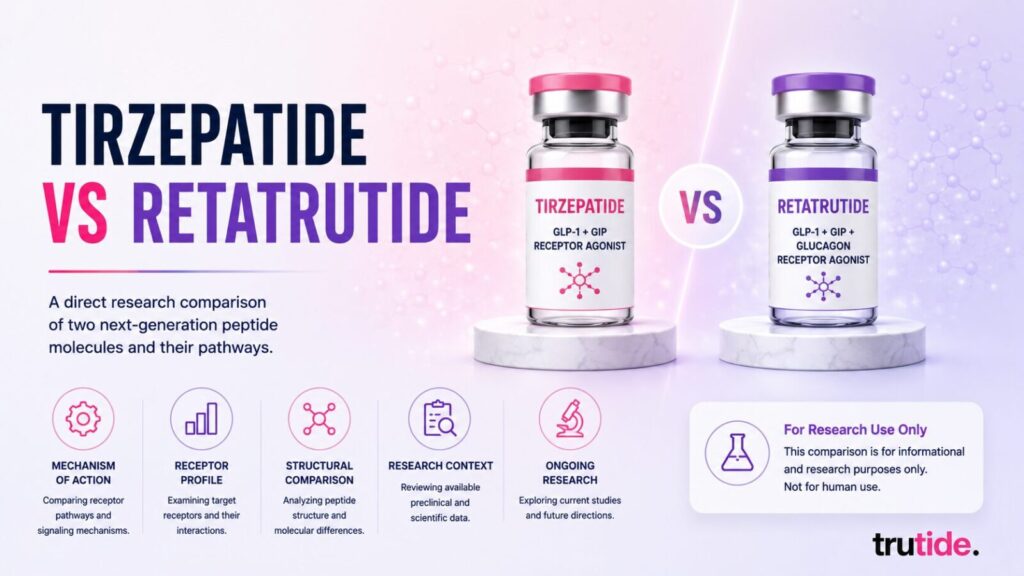
Tirzepatide and retatrutide are two of the most significant incretin-based research compounds, and they are frequently compared because they represent successive generations of the same design approach. Tirzepatide is a dual agonist, activating the GLP-1 and GIP receptors. Retatrutide is a triple agonist, adding a third target — the glucagon receptor — on top of those two. The practical difference between them comes down to that third receptor and the metabolic pathway it engages. This guide compares the two compounds directly: their receptor targets, what the glucagon receptor adds, their pharmacokinetics, and which suits a given research question.
Tirzepatide vs retatrutide at a glance
| Property | Tirzepatide | Retatrutide |
|---|---|---|
| Class | Dual agonist | Triple agonist |
| Receptors | GLP-1 + GIP | GLP-1 + GIP + glucagon |
| Incretin activity | Yes (both incretins) | Yes (both incretins) |
| Glucagon receptor activity | No | Yes |
| Additional pathway | — | Energy expenditure, hepatic metabolism |
| Half-life extension | Fatty acid acylation | Fatty acid acylation |
| Typical dosing in research | Once weekly | Once weekly |
| Vial size (Trutide) | 30 mg | 30 mg |
Trutide supplies both Tirzepatide and Retatrutide at ≥98% HPLC purity, independently tested by Janoshik Analytical.
The shared foundation
Both compounds are built on the same incretin foundation. Both activate the GLP-1 receptor (glucose-dependent insulin secretion, glucagon suppression, slowed gastric emptying, appetite signalling) and the GIP receptor (further glucose-dependent insulin secretion plus lipid-metabolism effects). Both are engineered with a fatty acid chain (acylation) that binds albumin, resisting DPP-4 degradation and extending the half-life to support once-weekly administration in research protocols.
In other words, everything tirzepatide does, retatrutide also does — the dual incretin mechanism is common to both. The difference is entirely in what retatrutide adds on top. For background on the incretin foundation itself, see our guides on GLP-1 receptor agonists and GLP-1 and GIP dual agonists.
The key difference: the glucagon receptor
The single distinction between the two compounds is retatrutide’s activity at the glucagon receptor — the third target that makes it a triple agonist rather than a dual one.
Glucagon is best known for raising blood glucose, which makes its inclusion seem counterintuitive. But glucagon receptor activation also has documented effects on energy expenditure (increasing metabolic rate) and hepatic lipid metabolism (influencing how the liver processes fats). These are the effects retatrutide’s glucagon activity is designed to engage. The glucose-raising tendency is counterbalanced by the strong incretin activity of the GLP-1 and GIP components, which enhance glucose-dependent insulin secretion and suppress glucagon’s glucose signal. The net result is a compound that adds an energy-expenditure and hepatic-metabolism dimension that tirzepatide’s dual incretin mechanism does not reach.
For a full treatment of the triple-agonist approach and the glucagon paradox, see our guide on GLP-1, GIP and glucagon receptor agonists.
Which suits which research
The choice between the two follows from the third receptor. Research focused on the dual incretin mechanism — the combined GLP-1 and GIP pathways and their effects on glucose-dependent insulin secretion and related metabolism — is served by tirzepatide, the more established dual agonist with a larger body of published research behind it. Research that specifically requires engagement of the glucagon receptor pathway — energy expenditure and hepatic metabolism alongside the incretin effects — calls for retatrutide, the triple agonist.
Neither is simply “better” than the other; they engage different numbers of pathways. Tirzepatide is the focused dual-incretin tool; retatrutide is the broader three-pathway tool. The research question determines which is appropriate. For full mechanistic overviews of each, see the Tirzepatide research guide and Retatrutide research guide.
Handling and reconstitution
The two compounds are handled identically in practice. Both are supplied as lyophilised powder in 30 mg vials, both reconstitute with bacteriostatic water using a standard single-stage protocol, and both reconstituted solutions are stored refrigerated at 2–8°C and used within 28 days. Neither requires the two-stage acidic reconstitution that some other peptides need. For general protocols, see our guides on how to reconstitute research peptides and how to store research peptides correctly.
Frequently asked questions
What is the difference between tirzepatide and retatrutide?
Tirzepatide is a dual agonist activating the GLP-1 and GIP receptors. Retatrutide is a triple agonist that adds a third target, the glucagon receptor. Both share the dual incretin mechanism; retatrutide adds glucagon receptor activity, which engages energy-expenditure and hepatic-metabolism pathways.
Is retatrutide just tirzepatide plus glucagon?
Conceptually, yes — retatrutide retains the GLP-1 and GIP incretin activity that defines tirzepatide and adds glucagon receptor activity on top. They are distinct engineered molecules, but the relationship is that retatrutide extends the dual mechanism with a third pathway.
Why does retatrutide include glucagon activity?
Glucagon receptor activation has documented effects on energy expenditure and hepatic lipid metabolism, beyond its familiar role in raising glucose. These are the effects the glucagon component is designed to engage. Its glucose-raising tendency is counterbalanced by the strong incretin activity of the GLP-1 and GIP components.
Which is better for research?
Neither is universally better — they engage different numbers of pathways. Tirzepatide is the focused dual-incretin tool with a larger published research base; retatrutide is the broader three-pathway tool. The research question determines which is appropriate.
Are they reconstituted the same way?
Yes. Both are supplied as lyophilised powder in 30 mg vials and reconstitute with bacteriostatic water using a standard single-stage protocol. Reconstituted solutions are refrigerated and used within 28 days. Neither requires a two-stage acidic reconstitution.
Can these compounds be used in humans?
No. Tirzepatide and retatrutide supplied by Trutide are intended strictly for in vitro laboratory and scientific research. They are not for human or veterinary consumption, clinical use, or self-administration.
Further reading
For full mechanistic overviews, see the Tirzepatide research guide and Retatrutide research guide. For the underlying receptor concepts, see GLP-1 receptor agonists, GLP-1 and GIP dual agonists, and GLP-1, GIP and glucagon receptor agonists.
Trutide supplies research-grade Tirzepatide and Retatrutide at ≥98% HPLC purity, independently tested by Janoshik Analytical. You will also need bacteriostatic water for reconstitution.
Research use only. This article is intended for qualified researchers only. All information is provided for educational and scientific reference purposes. Nothing in this article constitutes medical advice. Tirzepatide and retatrutide supplied by Trutide are strictly for in vitro laboratory research and are not for human or veterinary use.
References
- Jastreboff AM, Kaplan LM, Frías JP, et al. Triple-hormone-receptor agonist retatrutide for obesity — a phase 2 trial. New England Journal of Medicine. 2023;389(6):514-526. doi:10.1056/NEJMoa2301972
- Frías JP, Davies MJ, Rosenstock J, et al. Tirzepatide versus semaglutide once weekly in patients with type 2 diabetes. New England Journal of Medicine. 2021;385(6):503-515. doi:10.1056/NEJMoa2107519
- Coskun T, Sloop KW, Loghin C, et al. LY3298176, a novel dual GIP and GLP-1 receptor agonist: from discovery to clinical proof of concept. Molecular Metabolism. 2018;18:3-14. doi:10.1016/j.molmet.2018.09.009
- Coskun T, Urva S, Roell WC, et al. LY3437943, a novel triple glucagon, GIP, and GLP-1 receptor agonist: from discovery to clinical proof of concept. Cell Metabolism. 2022;34(9):1234-1247. doi:10.1016/j.cmet.2022.07.013
- Rosenstock J, Wysham C, Frías JP, et al. Efficacy and safety of a novel dual GIP and GLP-1 receptor agonist tirzepatide in patients with type 2 diabetes (SURPASS-1). The Lancet. 2021;398(10295):143-155. doi:10.1016/S0140-6736(21)01324-6
Last updated: 11 June 2026